Contents
Shreveport Times (Louisiana) — Spring drought
Panama City News Herald (Florida) — Influence and Inspiration
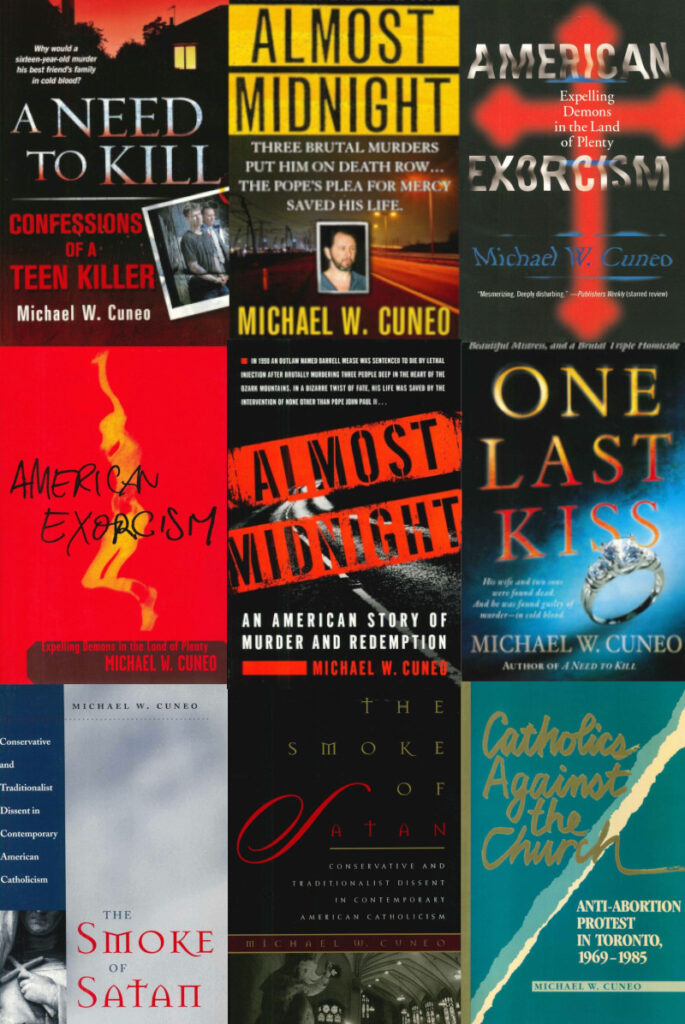
The Advocate (Baton Rouge, Louisiana) — ‘Smoke’ examines Catholic fundamentalism
The News & Observer (Raleigh, North Carolina) — Absorbing Book of Southern Intrigue
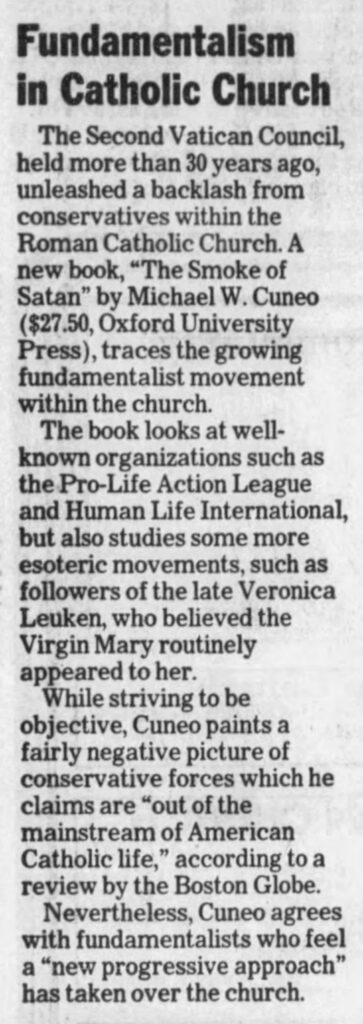
Lincoln Journal Star (Nebraska) — Fundamentalism in Catholic Church
Science et Esprit (Montréal) — Comptes Rendus
Journal-Courier (Jacksonville, Illinois) — American Exorcism
The Eastern New Mexico News (Clovis, New Mexico) — Books Preview
Tallahassee Democrat — John Hawkes Nails the Role of His Career
Pop Matters — Get Right with God
Skeptical Inquirer — A Sociologist’s Journey into the American Heart of Darkness
The Catholic Register — Catholics Against the Church
Word Trade (Chapel Hill, North Carolina) — The Smoke of Satan
Religious Studies Review — Catholics Against the Church
Millennial Stew (Boston) — The Smoke of Satan
Choice — Catholics Against the Church
Good Reports — American Exorcism
curledup.com — Almost Midnight
The Canadian Catholic Review — The Revivalist Vision of the Church
The Times of Northwest Indiana (Munster, IN) — The Smoke of Satan
Review of Religious Research — Catholics Against the Church
Cushwa Center — The Smoke of Satan
Free Inquiry Group — American Exorcism
Studies in Religion / Sciences Religieuses — Catholics Against the Church
The Desert Sun (Palm Springs, California) — American Exorcism
Sociology of Religion — The Smoke of Satan
The Hopewell Christian Educator — God, Pentecostals and the Pope in the Ozarks
Review of Religious Research — The Smoke of Satan
Wisconsin State Journal (Madison) — Little-known Catholic fundamentalists profiled
St. Louis Post-Dispatch — A Richly Detailed Exploration

Shreveport Times (Louisiana)




Panama City News Herald (Florida)

[excerpted]
INFLUENCE is an interesting thing.
When “The Exorcist” was published I was 3 years old.
I was 5 when the movie based on it was released.
The book and the film had no impact on me at the time, but they changed the world I was so newly born into in ways we’re still discovering. They also were hugely influential on my fifth John Jordan novel, “Blood Sacrifice,” decades after they first came out.
In “Blood Sacrifice,” ex-cop/prison chaplain John Jordan investigates the death of a young woman who was undergoing exorcism when she was killed.
While doing research for “Blood Sacrifice,” I read the nonfiction book “American Exorcism: Expelling Demons in the Land of Plenty” by Michael Cuneo.
The book is described by its publisher as “a guided tour through the burgeoning business of exorcism and the darker side of American life. There is no other religious ritual more fascinating, or more disturbing, than exorcism. This is particularly true in America today, where the ancient rite has a surprisingly strong hold on our imagination, and on our popular entertainment industry. We’ve all heard of exorcism, but few of us have ever experienced it firsthand.”
“Publishers Weekly” had high praise for the book: “Lucidly written and riveting as any horror novel, Cuneo’s excursion into the darker paths of American faith offers a deeply disturbing, ironic vision of what [Cuneo] sees as the unintended consequences of popular culture for the modern religious imagination.”
I highly recommend Michael Cuneo’s “American Exorcism.”
The Advocate (Baton Rouge, Louisiana)



WHAT HAPPENS when a 2,000-year-old organization decides to change the rules? You end up with many bewildered and unhappy members. To some degree this has been the fallout from the Second Vatican Council, the Roman Catholic Church’s attempt to reconcile an ancient, mysterious faith with the modern world.
The three-year conclave held more than 30 years ago touched on every aspect of Catholic life, from the role of priests and nuns to the treatment of other religions, and produced legions of critics on both the left and the right. Liberals said the council didn’t go far enough, failing, for example, to allow married priests. Conservatives blasted the council for going too far. The elimination of the Latin Mass still rankles.
Michael W. Cuneo uses the Second Vatican Council and the seismic shift it unleashed as a framework for vivid profiles of the church’s unnoticed players — Catholic fundamentalists. His well-researched, eye-opening book shows them to be a fascinating and, at times, bizarre and disturbing subgroup, whom even faithful Catholics would have a hard time embracing. With crisp and concise writing, Cuneo uses colorful anecdotes to shine a light on a mostly unknown part of the church.
●
The News & Observer (Raleigh, North Carolina)
By Andrew Hudgins
[excerpted]
IN ALMOST MIDNIGHT, Michael Cuneo doesn’t make a mystery out of the slaying, in rural Missouri, of Lloyd Lawrence, his wife, Frankie, and his paralyzed grandson, Willie. We know from early on that Darrell Mease, a Vietnam vet and methamphetamine-cooker, did it – and then that he was captured, tried and sentenced to death. We even know that he avoided the fate the jury sentenced him to, though it takes a while to find out how.
The story moves briskly, particularly as Mease and his girlfriend run all over the South and West, hiding from the villainous Lawrence, who put out a contract on them for stealing a batch of meth. Not knowing what else to do, Mease returned to face Lawrence, and killed the wife and grandson because they were there.
Cuneo is a terrific reporter. He does a superb job of capturing Mease’s jailhouse conversion and the reasonable skepticism that greets it. He makes us understand that Mease genuinely believes that “God is his lawyer” and that the deity has promised his new client that he will not be executed but released from prison. Through a series of events that seem very much like a miracle, Mease gets the first part of his prayer; the second part has yet to happen.
●
Lincoln Journal Star (Nebraska)

By Journal Star staff
Science et Esprit (Montréal)


Michael W. Cuneo ● The Smoke of Satan ● New York ● Oxford
par Jean-Guy Vaillancourt
[excerpted]
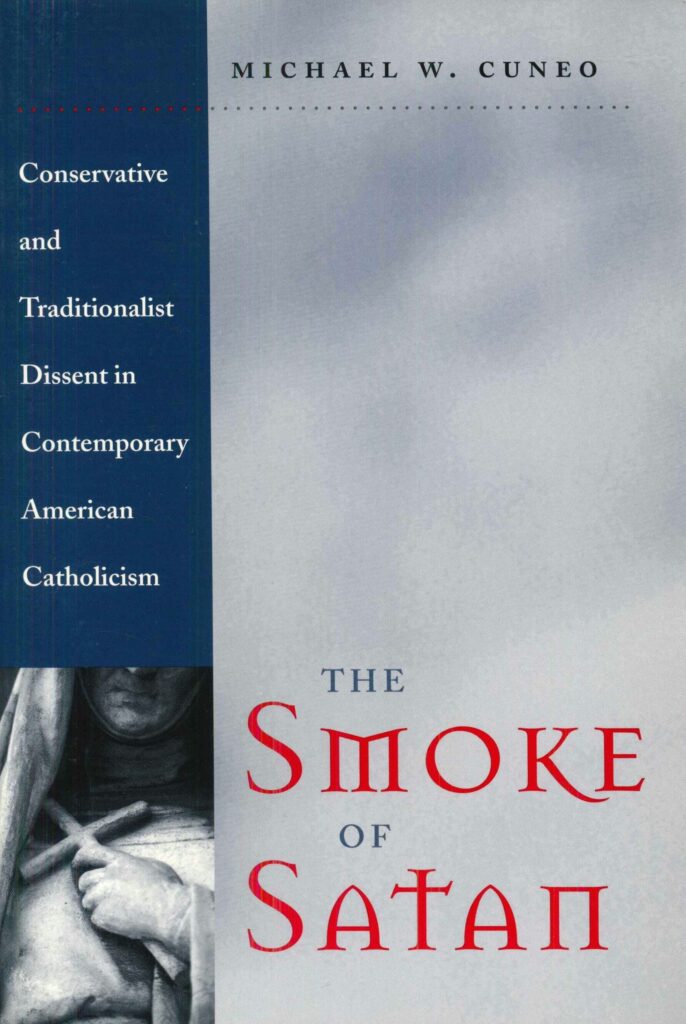
THE TITLE of this remarkable book on right-wing Catholics is provocative but somewhat confusing. The subtitle – Conservative and Traditionalist Dissent in Contemporary American Catholicism – gives a better idea of its actual content. What we have here is a beautifully crafted and magnificently structured piece of qualitative empirical research on the right-wing fringe of Catholic extremists who adorn the religious and political scene in contemporary North America.
The Smoke of Satan is based on qualitative documentary analysis, extensive observation, and in-depth interviews with significant leaders and members of these groups. It is lively and eminently engaging, and unhampered by the heavy paraphernalia of research methodology which is better left in the kitchen rather than served in the dining room. The book reads like good high-brow journalistic reporting, but it actually is excellent sociological description and analysis.
●
I can only encourage readers to get hold of this wonderful and fascinating book.
Journal-Courier (Jacksonville, Illinois)

By Mary A. Jacobs
THIS BOOK arrives on the scene with the claim that “far from being a rare and unusual practice, exorcism is alive and well in America today.” In researching the book, author Michael Cuneo attended more than 50 exorcisms across the U.S.
The author’s analysis of the religious landscape surrounding exorcism is astute. He begins with a look at the influential 1973 movie “The Exorcist” and moves on to survey exorcism movements in the Catholic, evangelical and charismatic worlds.
He offers a particularly penetrating look at the “Satanic panic” of the 1980s, the plethora of Christian counselors who uncovered “repressed memories” of Satanic ritual abuse and the resulting growth of “deliverance” and “spiritual warfare” ministries among evangelicals.
The Eastern New Mexico News (Clovis, New Mexico)


By News staff
● The Clovis Incident by Pari Taichert interweaves a quirky sleuth, a friend in danger, a hunky cop, and a passel of possible space aliens in a beguiling new mystery set in Clovis, New Mexico.
● Almost Midnight: An American Story of Murder and Redemption by Michael Cuneo reconstructs the case of an inmate on death row for triple murder, and the bizarre twist of fate that saved his life at the last moment when Pope John Paul II intervened and persuaded the governor to commute the sentence.
● The Lost Adams Diggings by Jack Purcell sifts through the many tales of lost treasure buried in the remote caves and canyons of New Mexico and the true stories of tireless prospectors who find the legend and mystery more alluring than the money.
Tallahassee Democrat (Florida)



Pop Matters


By John Duffy
[excerpted]
WRITER MICHAEL CUNEO is fascinated with the fringes of mainstream religion in America. His books display an interest in how religion intertwines with the social fabric of American life, but also how it can lead to consequences completely out of step with Judeo-Christian doctrine.
His previous book, American Exorcism, explores in detail the ancient practice of exorcism and its clandestine use by a surprising number of American religious groups, from renegade Catholics to backwater Evangelicals. In Almost Midnight, Cuneo traces the life story of Darrell Mease, a Missouri outlaw convicted in a trio of shotgun killings. Written as a piece of investigative journalism in the mold of Truman Capote’s genre-defining In Cold Blood, the book is especially interested in the elements of faith, outlaw justice, and revenge at play in Mease’s story.
Raised in the Ozarks, poor and white and supremely devout, Mease seemed destined to become a preacher. Steeped in the Pentecostal faith endemic to the region, he was an eminently likeable kid whose piety was only outweighed by unfortunate circumstances.
Drafted into the Marine Corps and sent to Vietnam as a combat engineer, Mease started using drugs heavily. Upon returning home, he fell in with the hard-living and hard-drinking culture of the Ozarks, where blood feuds last through generations and outsiders are greeted with disdain verging on outright hostility.
●
Cuneo spent over a year exploring the backroads and juke joints of Mease’s native southern Missouri hills. He attempts throughout Almost Midnight to come to terms with the seeming inevitability of Mease’s triple homicide. Reveling in tales of the rough-and-tumble Ozarks, he suggests that Mease had little chance of ending up as anything more than a desperado.
●
Skeptical Inquirer

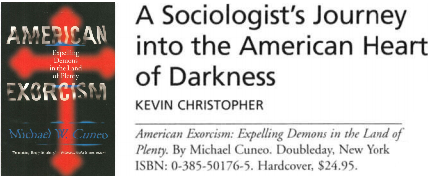

FOR SKEPTICS and most other people, the word exorcism immediately evokes images of Catholic priests, holy water, and bizarre, other-worldly behavior. Most of the popular literature and media coverage focus exclusively on this Hollywood version of modern exorcism, a vicarious adventure into the dangerous side of religious experience. American Exorcism takes us beyond such cliché into the real believing subculture and the broader phenomena of demonology and ritual.
Author Michael Cuneo delves deeply into modern American beliefs in demon possession and the various practices of demon expulsion. Although his opening chapters focus mostly on exorcism as a Roman Catholic ritual, Cuneo is quick to disabuse readers of the common assumption that the task of expelling demons is limited to priests. His later chapters closely examine the history and current practice of Middle-America exorcism – the deliverance ministries of Baptist, charismatic, and Pentecostal churches and deliverance groups. Cuneo is also careful to make sure the reader understands that although Protestant deliverance ministry and the resurgent Catholic rite of exorcism are essentially grass-roots practices, the renewed popular belief can be credited almost entirely to Hollywood.
“This conjuncture of commercialism and religious ritual, of profits and piety, should come as no surprise,” Cuneo writes. “Over the course of the twentieth century the popular cultural industry, with its endless run of movies, books, and digital delights, has gained a pervasive influence over the national consciousness. It has become part of the very air that Americans breathe and, as such, it has attained an enormous capacity for shaping everyday beliefs and behaviors . . . When Hollywood and its allies put out the Word, somebody’s guaranteed to be listening.” Cuneo repeatedly reminds the reader of the role of American media in the resurgence of the belief in demonic possession. Only the most willfully naïve reader could overlook the role of motion pictures, TV talk shows, book publishers, and the insatiable appetite for publicity among exorcism authors and self-styled “researchers” after reading Cuneo’s perceptive accounts of the rise of demonic awareness in the land of plenty.
American Exorcism is a remarkable synthesis of interviews, historical research, media studies, and hands-on field research. Cuneo interviews the various players in the modern exorcism revival. He offers compelling assessments of desires and motives of the exorcists and the possessed – tempered by objective evidence and judgment. He shows forbearance and sympathy to those who participate in exorcism and deliverance ministry, but he is also skeptical and frank.
Cuneo begins his book with a poignant and timely lamentation of the modern Catholic priesthood: “The past three decades haven’t been particularly kind to the Catholic priesthood. One would be hard-pressed to find another profession that has fallen harder or further from grace in so short a period of time.” He notes the dramatic thinning of the ranks beginning in the 1960s and 1970s, the frantic scramble to find relevance in the modern world, and the endless sexual scandals. The image of the Catholic priest, writes Cuneo, “has more often been the priest as pious fraud, the priest as philanderer, the priest as yesterday’s man – equivocating, beleaguered, and thoroughly redundant.”
In one exceptional area, however, the priest remains a cultural hero. “That area,” writes Cuneo, “is exorcism, and it is the priest-as-exorcist that has somehow managed, in defiance of all odds, to retain a heroic grip on the popular American imagination.” Modern Catholic liberals had hoped that exorcism would be relegated to Church history along with other medieval trappings and customs. What such Catholics never anticipated, according to Cuneo, was the modern media’s role in breathing new life into the ancient rite of exorcism.
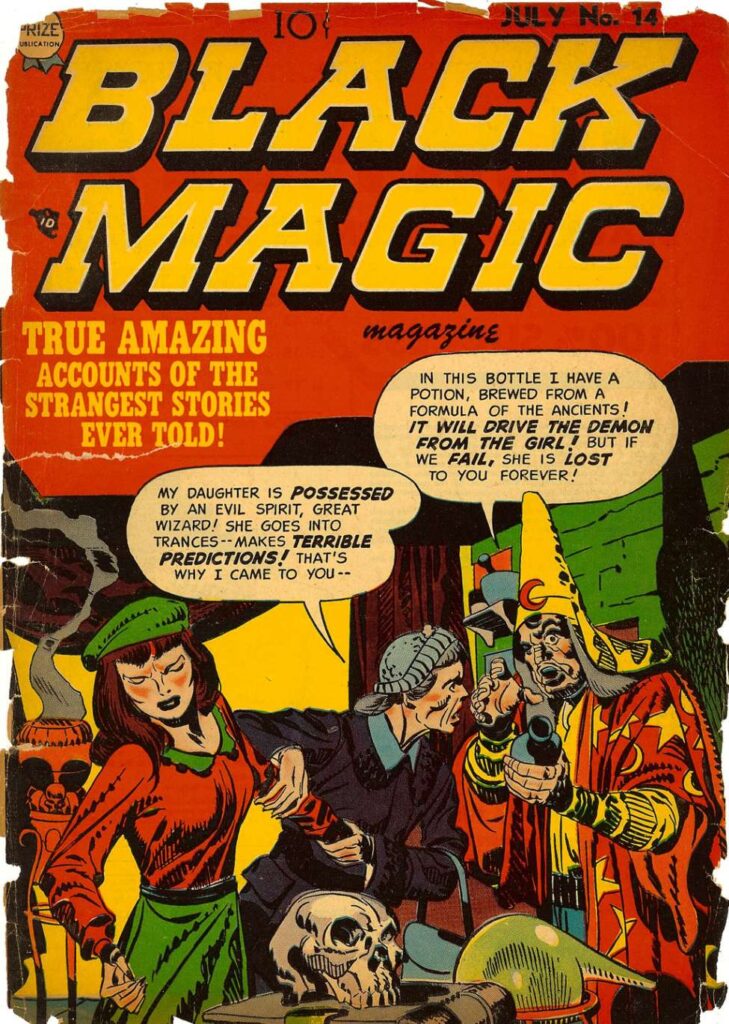
In the first four chapters, Cuneo deftly sketches out the sundry sources of the exorcism revival. He begins with the well-known pop Ursprung: William Peter Blatty’s 1971 novel, The Exorcist, and the 1973 film of the same title that it inspired. He characterizes Blatty’s work as a massive structure of fantasy resting on the flimsy foundation of a priest’s 1949 diary account of the possession of a young boy in Mount Ranier, Maryland.
Cuneo then introduces the reader to fascinating and seldom-cited sources: ex-Jesuit priest Malachi Martin, author of the 1976 book, Hostage to the Devil, paranormal authors Ed and Lorraine Warren, and, surprisingly, the grandfather of pop-psychology and self-help, The Road Less Traveled author M. Scott Peck.
Malachi Martin pronounced his final vows as a Jesuit in 1960 and took a position at the Vatican’s Pontifical Biblical Institute. He abruptly left his post in 1964 and the Society of Jesus in 1965, after being granted a provisional release by Pope Paul VI. Nearly fifty years later, there are conflicting accounts of why Martin, such a promising scholar, left everything behind. Cuneo writes:
“According to the most popular account (which is the one usually favored by Martin himself), he felt morally compelled to leave the priesthood over the new, decidedly more liberal direction the Catholic Church was taking as a result of the Second Vatican Council. Unfortunately, this stricken-soldier-of-conscience version of events hasn’t always squared with the facts. Far from being a tormented conservative during his years in Rome, Martin was actually a theological liberal, and while the council was in full swing, he was closely (and publicly) aligned with such leading liberal lights as Monsignor George Higgins and the eminent American Jesuit John Courtney Murray.”
Digging further, Cuneo finds “fairly reliable evidence” that Martin threw away his religious career in the wake of “romantic intrigue” – an affair that occurred in 1964 while he taught theology part-time at Loyola University of Chicago’s Rome Center.
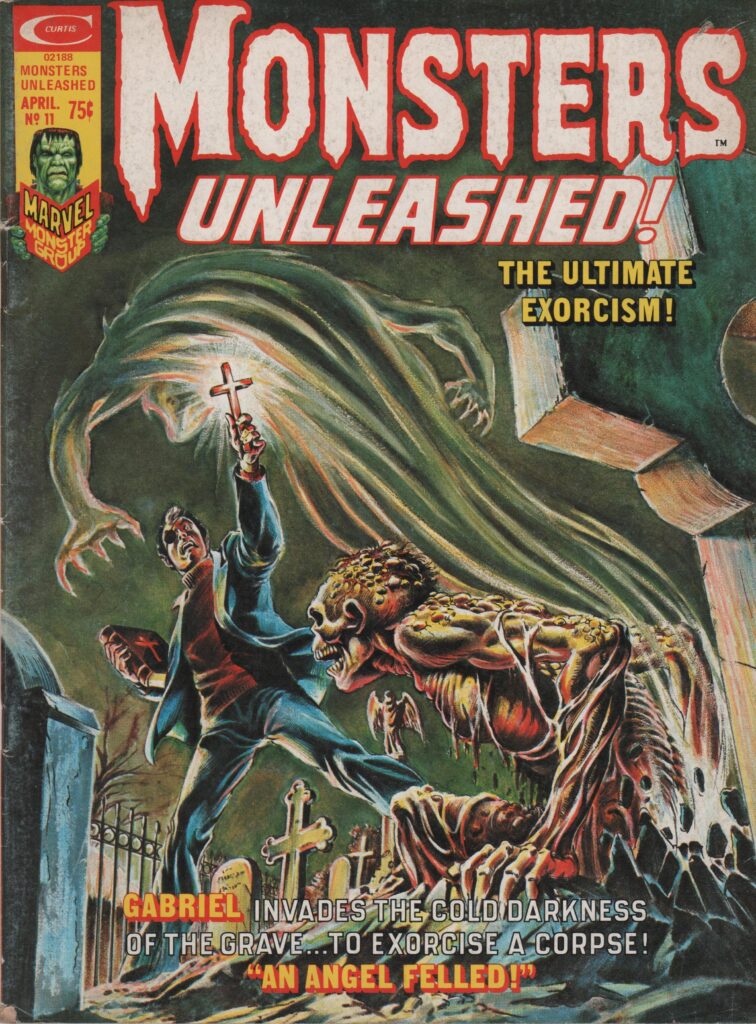
If readers are to believe Martin, Satan was hard at work in New York City during the 1970s. He claims that the possessions and exorcisms described in Hostage are true accounts. Cuneo checks with Catholic experts, including Franciscan Father Benedict Groeschel, the expert Catholic officials turned to in the 1970s and 1980s when they were confronted with the “inexplicable.” Groeschel was not aware of anything on the scale Martin portrays. Furthermore, Groeschel and others insist that for the mainstream Catholic Church, exorcism was the last resort; earthly explanations were preferred and pursued first.
In his 1983 book, People of the Lie: The Hope for Healing Human Evil, Peck is unequivocal about his belief in demonic possession, and he remains a staunch believer in supernatural demonic possession to this day. Many in the charismatic deliverance movement see People of the Lie as a mainstream validation of their beliefs. When Cuneo asked Peck in a phone interview whether he thought that exorcism would someday become a serious subject of scientific investigation, Peck expresses doubt for absolutely shocking reasons. He is not pessimistic due to the fact that there is no credible evidence for the reality of demonic possession. Instead he asserts – in the tradition of a dime-a-dozen pseudoscientists rather than a trained psychiatrist – that the “country’s intellectual and religious elites” are to blame, including “the leaders of the American Catholic Church,” who “have seemed determined to keep the door shut.”
In Part III, “Charismatic Deliverance Ministry,” Cuneo sets Catholicism aside and begins with an account of a fifteen-minute exorcism of a young man named Paul. Paul, plagued by years of aberrant sexual fantasies and violent urges, had driven 200 miles to Kansas City to obtain an exorcism from Protestant deliverance ministers Ellen and Felix. The rite Cuneo describes is not an all-night vigil of sweating priests dodging projectile vomit. It involved a prayer, a recitation of Psalm 37 and Luke 10:17-19, some speaking in tongues, and a prayer of repentance followed by a prayer of exorcism appealing to the power of Jesus Christ, repeated six times for each demon within Paul. Cuneo remarks that the “whole business” was “orderly and efficient.” He also includes a postscript stating that six months later, Paul claimed that he had not experienced any of his old symptoms and “for the first time in his life felt truly at peace with himself.”
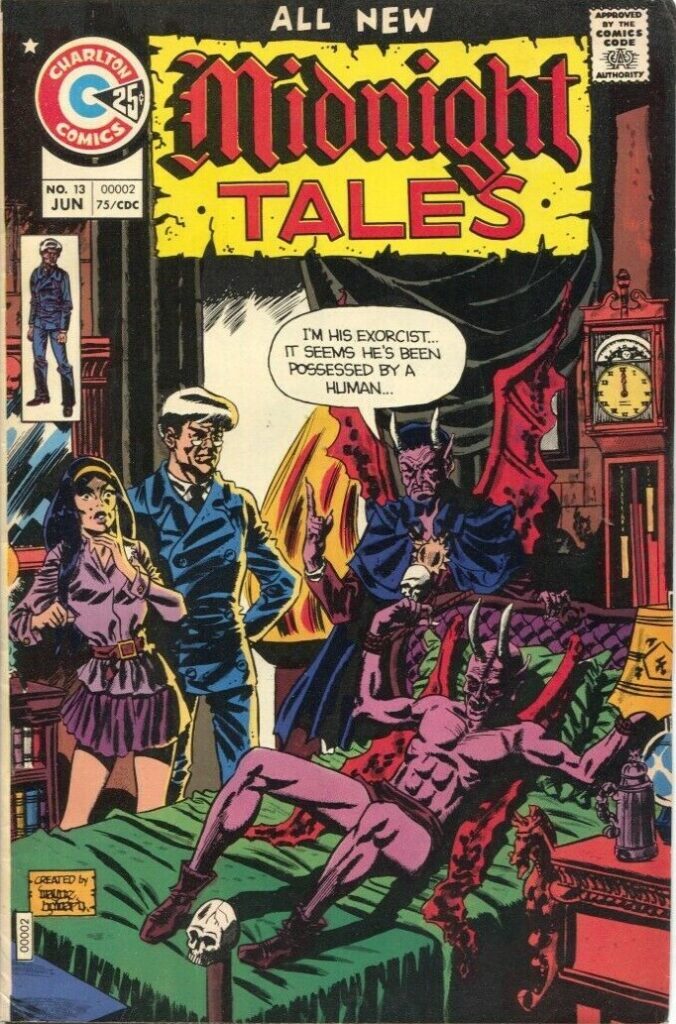
Cuneo then recounts the history of the rise of modern Pentecostal and charismatic deliverance ministry. Although it dates as far back as the very beginning of Pentecostalism in Los Angeles in 1906, the modern revival can be traced to the 1960s. At that time, deliverance ministry was a sporadic guerrilla movement, led by mavericks like Disciples of Christ minister Don Basham, Pentecostal minister Derek Prince, and, among charismatic Catholics, a Dominican priest named Francis MacNutt.
Cuneo’s historical account of deliverance ministry from the 1960s through the 1980s is filled with quotations from his interviews, providing an intense human portrait of what both leaders and followers in the movement felt and the role deliverance ministry played in their lives. Readers will also find a continuing interplay between Catholic and Protestant brands of exorcism. For instance, Malachi Martin’s pulp thriller, Hostage to the Devil, was a great influence on some of the modern Pentecostal deliverance ministers Cuneo spoke with, and many Catholics turned to Pentecostalism in their quest to infuse their faith with renewed fervor.
Cuneo spends time at Hegewisch Baptist Church in Indiana with Pastor Mike Theirer, “the hardest working exorcist in America.” His account stands in complete contrast to the more private and peaceful affair described above. Theirer’s deliverance sessions are auditorium affairs. “Throughout the auditorium, demoniacs are paired off with exorcism ministers,” writes Cuneo, who himself helped to wrestle down a particularly violent demoniac to prevent him from further battering Pastor Mike. People belched and (literally) vomited their demons out in an intense charismatic spectacle.
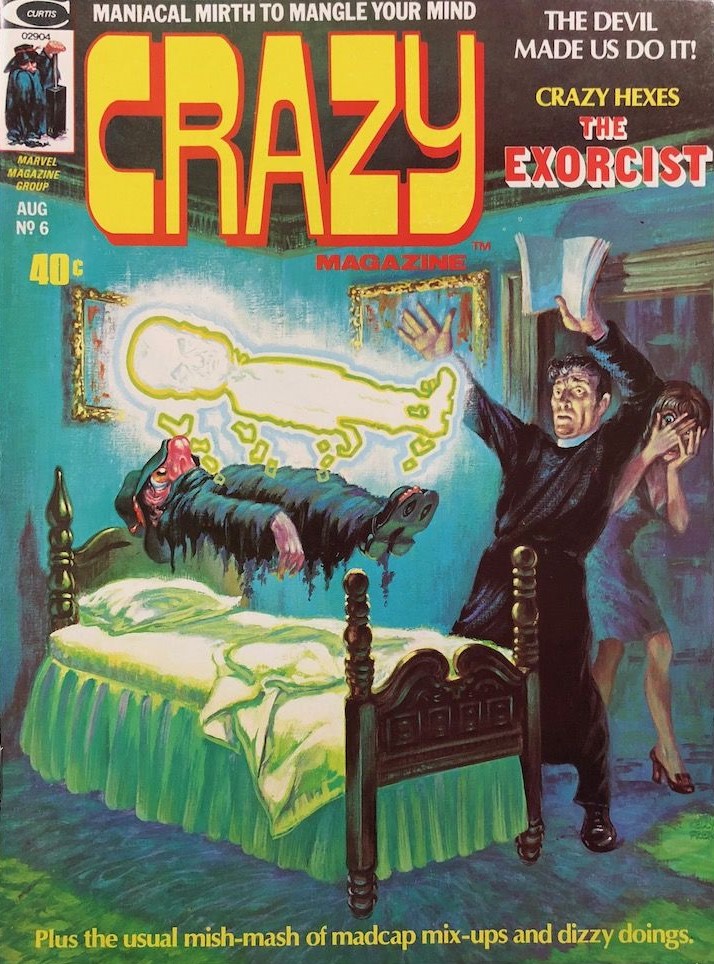
Cuneo’s close involvement with congregations practicing deliverance ministry gives him a compelling inside look and first-hand perspective on the conformist (sometimes cult-like) pressures exerted on members regarding belief and practice. Cuneo writes:
“Consider also the distinctive style of so many charismatic prayer groups: the ecstatic worship, the gushing emotionalism, the breathless solidarity. All of this gave rise, as often as not, to an atmosphere of suggestibility, of hothouse conformity. Individual charismatics, even relative newcomers, easily surmised what was expected of them in the way of belief and conduct, and there was no shortage of cues to help them along. Imagine a fairly new recruit to the renewal movement, impressionable, eager to please, seeing two or three, or fifteen or sixteen, spiritual brethren writhing and moaning in demon-induced torment. And then seeing the performance repeated time and again. It would take an iron act of will, arguably, for such a person not to go along for the ride.”
Cuneo describes how, at a symposium on deliverance, he himself was confronted by an overly zealous charismatic convinced that he was possessed. He also relates interview accounts of fascistic group leaders who quashed dissenters by attributing their complaints to demons of willfulness and condemning them to corrective exorcisms. He stresses, however, that such abuses are the exception rather than the rule.
Michael Cuneo’s conclusions on the actual existence of demons and the use of deliverance ministry and exorcism will almost certainly disappoint many Skeptical Inquirer readers who feel that the throat of patently unscientific nonsense should be slit wide open. Cuneo reserves judgment on many matters for which skeptics will see a clear verdict. After sitting in on fifty exorcisms, he is unequivocal about the fact that he saw nothing supernatural – certainly nothing out of The Exorcist or Malachi Martin’s salacious pulp-religion paperbacks. However, he remains equivocal about the possibility that demons exist. While his views on the efficacy of exorcism are tempered by documented tragedies of exorcists inadvertently killing their hapless subjects, Cuneo, who conducted follow-up interviews of people whose exorcisms he had observed, apparently accepts that exorcism might have therapeutic value.
Cuneo does emphasize one conclusion that all skeptics will gladly embrace. The Holy Army of priests, ministers, and laity who do battle with demons unquestionably takes its lead from the American mass media. Without Hollywood, ABC, or Malachi Martin’s publisher, the exorcism business would never have gotten off the ground. While Cuneo may in some cases be slow to condemn what is scientifically damnable, I believe that no skeptic’s library on occult or supernatural claims would be complete without American Exorcism. Cuneo has done quality research on all levels and from many angles. He opens the door for readers into a strange and amazing world, where people fervently believe that Satan and his minions are at work in a struggle that is simultaneously personal and cosmic. He also does an excellent job tracking the media’s role in popular belief, and he is refreshingly scathing in pointing out those who see religious beliefs as a means to pop fame.
The Catholic Register


Michael W. Cuneo. Catholics Against the Church (University of Toronto Press; $40 cloth, $16.95 paper)
By Suzanne R. Scorsone
[excerpted]
MICHAEL W. CUNEO is not only bright, thorough and systematic: the guy can write. The concluding chapter is perforce in sociologese. The rest of the book is in plain, vivid English. Whether or not you agree with all his analyses, you will find this book difficult to put down.
I am particularly struck by the objectivity, clarity and care with which Cuneo has laid out the perceptions and concerns of the various movement subgroups. He has his opinions, but allows the activists to speak for themselves. This is all the more admirable given the tendency of the wider society to stereotype all anti-abortionists.
Cuneo identifies three main categories of activists: civil rights, family heritage and Catholic revivalist.
●
For Catholic revivalists, according to Cuneo, anti-abortion activism is a venue for expression of dissatisfaction not only with contemporary society but with the post-conciliar Catholic Church.
“It seems to revivalists that the Catholic Church in North America has deserted the God of Abraham, Isaac and Jacob and converted to the Feuerbachian god, that projection onto the cosmos of humanity’s deepest aspirations and unrealized possibilities,” Cuneo writes. “In attempting to make faith relevant, progressives have debased it to a weepy sentimentality or, at best, a sociological hypothesis and, accordingly, have removed any compelling reason for becoming or, for that matter, remaining a Catholic” (p. 193).
As to Church structure, Cuneo writes, revivalists invoke a conspiracy theory. “Liberal theologians and diocesan bureaucrats, no longer themselves in possession of supernatural faith, have assumed the role of ‘second magisterium’ and are determined to convert the Church to the characteristic values and thought modes of secular humanism . . . This ‘revolt of middle management,’ according to revivalists, has brought into the open a confrontation of forces struggling for control of the Church” (p. 194).
The revivalists see themselves as a faithful remnant of laity, calling the Church to take a counter-cultural stand against the broader secular society.
Cuneo does overcome stereotypes. He makes it clear that revivalist Catholics are not anti-intellectuals defending their status against the enlightened. Their ranks are heavy with PhDs and professionals, along with white and blue-collar workers. The mothers of six tend to be university graduates who have chosen to remain at home with their children. Some revivalists are indeed nostalgic for the Latin Mass and the certainties of their youth, but most of these have acted on reflection. They are often under 30 and/or converts: they have chosen their piety.
The younger revivalist activists tend to be politically distant from the right. They trust neither capitalism nor communism: they see abortion-on-demand as symptomatic of the shallowness of the prevailing consumerist culture. Cuneo makes a point of saying that revivalist activists tend to be opposed to capital punishment, knocking yet another stereotype into a cocked hat.
●
So would I suggest that you read this book to better understand the anti-abortion movement in Canada?
Definitely.
This is good social science, very good social science. I wish there were more of it around.
Word Trade (Chapel Hill, North Carolina)


Michael W. Cuneo. THE SMOKE OF SATAN (Oxford)
AT THE site of the Vatican Pavilion at the old World’s Fair grounds in Queens, New York, where the late Veronica Lueken for years came to receive messages from the Blessed Virgin Mary, her followers still gather with apocalyptic expectancy before a portable statue of the Virgin. They are convinced that virtually the entire world, including the great majority of Catholics, will soon perish in a horrible chastisement, and that they alone will be saved.
In the theological underground of American Catholicism, mostly hidden from public view, the followers of Veronica are just a few among the many who regard both the broader society and the broader church as irredeemably corrupt.
Now, Michael Cuneo’s THE SMOKE OF SATAN brings these groups vividly to life, shedding valuable light on the current state of Catholicism in North America – and, more generally, on religion in our society.
Images on television and in the popular media have made the Christian right a household concept – but what that usually means is the Protestant Christian right. Cuneo’s insightful, provocative study highlights the equally vigorous though less well-known Catholic counterparts, ranging from the Marianists, such as the followers of “Blessed Veronica” of Bayside, to picketers at abortion clinics across the United States and Canada (militant lay Catholics who believe that “public witness” is a vocational enterprise of the highest order, one which the vast majority of bishops, priests, and nuns are too lacking in faith and nerve to perform themselves); from separatists who believe that even Rome itself has fallen and that true Catholics should withdraw and form alternate communities, to Latin Mass advocates who believe the reforms of Vatican II are the work of Satan himself.
These American Catholics are united by a common conviction: in the space of just several decades, the mainstream Catholic church in the United States and elsewhere has fallen into alarming decline, and the task of preserving authentic Catholicism (and thus Christianity itself) from outright extinction has fallen to small bands of the truly faithful. As Cuneo draws striking portraits of these faithful few, he also provides some fascinating asides on contemporary issues, including an innovative analysis of the ideological relationship of right-wing Catholic groups with the militia movement and a provocative assessment of militant Catholic prolife activism.
In 1972, speaking in the aftermath of Vatican II, Pope Paul VI said “the smoke of Satan has entered by some crack into the temple of God.” In this first full-scale account of Roman Catholic fundamentalism, Cuneo details what these disaffected Catholics believe the “smoke of Satan” to be, and what they plan to do to halt its spread.
Cuneo’s profiles of these right-wing groups and the various strategies they have adopted in attempting to carry out this task make for one of the most fascinating stories in contemporary American religion.
Religious Studies Review

Michael W. Cuneo. Catholics Against the Church (University of Toronto Press)
By Fred Maher
FASCINATING study.
Anti-abortion activism within the Catholic Church in Canada is interpreted as a struggle for the soul of the Church. “Revivalists” take to the streets to protest the perceived failure of the clergy to oppose, with real commitment, abortion and moral decay generally. Clerical lack of commitment is attributed to the priority the bishops place on ecumenism and on their alliance with “Social Justice” Catholics, who are more comfortable than the “Revivalists” with Vatican II, pluralism, and moral relativism.
Serious, insightful, and accessible. Anyone interested in the fault lines in the Catholic Church and/or the politics of abortion should read this volume.
Millennial Stew (Boston)


Michael W. Cuneo: The Smoke of Satan (Oxford, 214 pages, with footnotes)
By G.B.S.
AN ILLUMINATING account of the schism which has occurred within contemporary American Catholicism since Vatican II, resulting in what the author has labeled as three distinct factions: Catholic Conservatives, Catholic Separatists and Catholic Marianists/Apocalypticists. Cuneo successfully presents the dominant themes which unite and, more often, divide these marginalized Catholics.
Though not dealing specifically with millennial issues, this book examines the unquestionably apocalyptic themes found within the Catholic Marianist/Virgin Mary phenomenon. Familiar apocalyptic Christian themes are echoed in the miraculous prophetic apparitions of the Virgin Mary, from La Salette, France, to Bayside, New York, including an imminent worldly cataclysm, the persecution of the true church, the evils of the modern (i.e., secular) world and the ever-present threat of communism.
It is interesting to note that many of the conspiracy theories and themes often trumpeted by conservative Christian Evangelicals such as the threat of a one-world religion and the controlling of international finance by a satanic elite called the Illuminati are also clearly present in the beliefs of these Catholic Apocalypticists. Unfortunately, so is the implicit and sometimes explicit anti-Semitism which so often accompanies such conspiratorial thinking.
Cuneo provides a fascinating glimpse not only into these movements and the attraction they hold for a growing number of Catholics, but also into the appeal that apocalyptic thinking can have for the marginalized and disenfranchised.
Choice

Michael W. Cuneo. Catholics Against the Church. University of Toronto Press. $40.00; paperback, $16.95
By D. Campbell
A READABLE, scholarly sociological and historical examination of the Canadian Catholic pro-life movement. Although its scope is intentionally narrower than Kristin Luker’s study of pro-choice and pro-life activists in Abortion and the Politics of Motherhood, Cuneo’s book is of much wider significance than its subtitle might initially suggest.
Both in his case studies of Canadian Catholic pro-lifers and in his treatment of “the politics of ecumenism” in the Canadian Catholic Church, Cuneo presents some provocative material that is of primary importance to those who wish to understand the recent history of the Roman Catholic Church.
Cuneo’s treatment of the Canadian bishops’ relationship with the pro-life movement underscores the not-so-subtle differences between the American and Canadian Catholic communities even as his penetrating portrait of contemporary “Catholic Revivalists” – a constituency sometimes called Catholic Traditionalists or Catholic Fundamentalists – illuminates a critical development in the recent history of the Catholic Church throughout the English-speaking world (and beyond).
Recommended for graduate and upper-division undergraduate students.
Good Reports

Michael W. Cuneo ● American Exorcism: Expelling Demons in the Land of Plenty
By Alex Good
WHEN WILDE wrote that life imitates art, he was really only stating the obvious. Life, considered as the way we choose to live our lives, is an art. The things we make instruct us (for good or ill) how to go about it.
But we should be wary of extending his epigram too far. As an example of what can happen if we do, Michael Cuneo brings us this report (from the trenches, as it were) on exorcism in America.
Before 1971 exorcism, or the casting out of demons, was an obscure Catholic ritual that few people knew anything about. That all changed with the publication of William Peter Blatty’s The Exorcist, a book that, by itself, gives its author a persuasive claim to being the most important Catholic novelist of the twentieth century. Its presentation of a pair of relevant (nay, heroic!) Catholic priests struck a chord with a church that was feeling under siege.
The notorious film version that came out two years later only further opened the gates of hell. Almost overnight a small cottage industry in exorcism sprouted up, even spreading to various Protestant denominations (though it has been hard for the Holy Rollers and other groups to match the spiritual cachet of the full Catholic ritual). Cuneo’s explanation for why this happened is commendably clear. In the first place he blames the media: Blatty and his spawn. The exorcisms Cuneo attends play out like amateur versions of scenes from The Exorcist and other movies, albeit without any of the special effects. It seems nothing is sacred from Wilde’s mimesis in reverse:

“Am I really suggesting,” Cuneo writes, “that the popular entertainment industry, with all its dreck and drivel, is capable of manipulating – actually manipulating – religious beliefs and behavior? Indeed, this is one of the main contentions of the present study, and there seems nothing (to my mind) especially far-fetched about it. Like it or not, the products of Hollywood and the tabloid media are an inescapable fact of life in contemporary America . . . they play a crucial role in shaping public sentiment and engaging the national psyche. Why should religiously inclined Americans be less susceptible to their charms than anyone else? When Hollywood or Oprah or Madison Avenue advertises the existence of demons and satanic cults, it is hardly surprising that at least some Americans will comport themselves accordingly.”
The second contributing factor has been the “therapeutic ethos of the prevailing culture.” The notion that one’s drunkenness and lust are the result of demonic infestation rather than personal weakness suits us well:
“No less than any of the countless New Age nostrums or twelve-step recovery routines on the current scene,” Cuneo writes, “exorcism ministries offer their clients endless possibilities for personal transformation – the prospect of a thousand rebirths. With its promises of therapeutic well-being and rapid-fire emotional gratification, exorcism is oddly at home in the shopping-mall culture, the purchase-of-happiness culture, of turn-of-the-century America.”
curledup.com

Almost Midnight. Michael W. Cuneo. Broadway Books. Hardcover. 352 pages

By Barbara Bamberger Scott
DARRELL MEASE is in prison for life, but not forever. God is his lawyer, and he figures the Almighty will spring him one of these days, for sure. After all, he was saved from execution by the Pope and he’s not even Catholic. With a miracle like that on your rap sheet, the sky’s the limit.
Not bad for a guy who murdered three people – man, woman and crippled teenager – in a cold-blooded vicious manner that certainly begged the death penalty, according to a jury of his peers. But Darrell is a man with few peers.
Michael W Cuneo, author and professor, has gone as deep into the life and ethos of Darrell Mease as anyone should dare. He has a respectful relationship with the murderer, and he wants the world to understand Darrell as well as he does.
Mease grew up in the hard-scrabble Ozarks, before Branson brought a modicum of respectability to what had always been seen as a hillbilly enclave, where local heroes were likely to be legendary bank robbers or mountain men with long knives. Darrell is a kind of local hero. Brought up Pentecostal, he is still adored by his mother, Lexie, who sees him as God’s instrument and who has spent hours on her knees praying for him. As a boy, Darrell was likeable and not much of a scholar, though he had smarts. He just loved to hunt and roam the woods, and he learned from his Daddy how to shoot and kill innocent critters.
Vietnam moved him up a gear in the killing game. He came back haunted by survivor’s guilt, though no one’s trying to make too much of that. Darrell had chances, like we all do, and he made a mess of two marriages and all attempts at gainful employment. He wasn’t lazy, and he had his pride. But he blew a lot of good opportunities and wound up in a nasty vendetta scenario with a man named Lloyd.
Lloyd was a mixed bag, like Darrell. He dealt hard drugs, and those who hated him were as many as those who thought him a pretty nice fellow. He’d play Darrell along, promising him things and not delivering, and finally put a hit out on Darrell, who, it must be said, was hoping to share Lloyd’s limelight as a bigtime drug empresario.
Darrell and the love of his life, Mary, left the Ozarks and traveled in a big crazy circle out West and back. Mary wanted to settle down, but Darrell was obsessed with the paranoid notion that Lloyd would somehow track him down. The only solution was to hit before he got hit. In the commission of this crime, he just had to knock off Lloyd’s wife and his paraplegic grandson, who happened to be at the scene.
Darrell and Mary took off again, Bonnie and Clyde-like, living the outlaw life out West. They held hands and looked at sunsets, and fought hunger and despair while she worked as a waitress. When finally apprehended, they were sleeping in their car, their last possession of any value. Not exactly an enviable finish to a grubby, violent story.
Darrell had a conversion while awaiting trial. Even those who were meeting him for the first time commented on his placid demeanor. But he was convicted and slated for lethal injection, and that seemed to be that. A date was set.
On January 27, Darrell’s death date, the Pope was going to visit Missouri, so the execution was postponed. It was well known that the Pope disapproved of capital punishment and wouldn’t like a man being executed on his watch. Who’d have thought it? The Pope personally asked the Governor of the state, Mel Carnahan (who was killed shortly thereafter in a plane crash), to “have mercy on Mr. Mease.” The Pope felt it would be unfair to stay Mease’s death for a few weeks just because of his visit, and then snuff him once his temporary savior was back in the Vatican.
On such a feeble thread Darrell’s life appended, and on Carnahan’s decision he was granted a permanent stay, in prison, with no chance of parole.
But Darrell, and his mom, believe he’ll walk free one day. That would make one hell of a sequel.
The Canadian Catholic Review
The Revivalist Vision of the Church
Michael W. Cuneo. Catholics Against the Church (University of Toronto Press; soft cover, $16.95)
By Keith Cassidy
[excerpted]
ANYONE seriously interested in the current state of the Catholic Church in Canada or in the abortion controversy must read this book. Not that this necessarily implies that all will agree with its contents – far from it – but the author has asked important questions, pursued his inquiries vigorously, and has presented his conclusions with considerable verve and intelligence.
This work is so rich and suggestive that a short summary of its argument is necessarily unsatisfactory. In essence, however, Cuneo maintains that the abortion controversy, rather than being a bond of unity among Catholics, is a source and symbol of bitter divisions.
Those Catholics (referred to by Cuneo as “Revivalists”) for whom abortion is a momentous issue on which there can be no compromise have found themselves frustrated and appalled by what they perceive as the timidity, accommodationism, and failed spiritual commitment of much of the hierarchy and its apparat. These have reciprocated with hostility or disdain.
Cuneo suggests that “Revivalist Catholicism” is based on the twin convictions that North American culture has lapsed into moral anarchy, which has been absorbed by the institutional Church, and that the authentic Church is “an enclave of stalwart believers” who are faithful to Catholicism’s unchanging teachings and “at war with the neo-paganism of society.”
More provocatively, Cuneo argues that the anti-abortion activism of Revivalist Catholics “is incompletely understood without an appreciation of its symbolic meaning.” In other words, even when their style of protest is counter-productive, it is a means of “producing and consolidating a contracultural religious identity.”
●
Among the book’s many strengths are its excellent case studies in which a social movement comes to life through the words and stories of real people. These are rendered with fairness and sensitivity.
Inevitably, comparison will be made with Kristin Luker’s Abortion and the Politics of Motherhood, or Faye Ginsburg’s Contested Lives. There seems no question that this study surpasses them, and is the best available at present of a North American anti-abortion movement.
Read it, disagree with it at times, and learn from it. This is a major piece of work.
The Times of Northwest Indiana (Munster, Indiana)

Review of Religious Research
Michael W. Cuneo. Catholics Against the Church. University of Toronto Press
By Anthony J. Blasi
[excerpted]
THIS IS A STUDY of a largely religious anti-abortion movement of Anglo-Canada. It is based on extensive observation and interviews, in the mode of much social movement research.
Cuneo found three empirical types of anti-abortion activist. The civil rights activists, who led the movement in its earlier years, were often not Catholic, but were allies of the bishops; they focused on the humanness of the unborn. Educated, pluralist, and pragmatic, this kind of activist could reach a compromise in the political process.
The family heritage activists, who make up the broader constituency of the movement, are suspicious of cultural elites who undermine traditional family values. Such elites, they reason, will not be persuaded by scientific evidence about the humanity of the fetus and are morally insensitive. These activists often had personal experiences which highlighted the values they see in question; they may have cared for a child born with “defects” or lost a child at birth. They deplore the willingness of civil rights activists to compromise. For them the movement is a moral crusade.
The revivalist Catholic activists focus on the failure of Canadian Catholicism to affirm transcendent values in the face of a materialistic culture. They reject the pluralist stance and openness to the secular world of post-conciliar Catholicism. For them movement activism is a ritual of identity, a way to demonstrate a Catholic authenticity which the official church fails to express.
Despite the controversies within controversies, Cuneo retains his objectivity throughout the volume. He also goes beyond abstractions and types, fleshing out his analysis with the drama and anxieties of real people. One is reminded of the style of Robert Park, who set out deliberately to destroy the stereotypes of African-Americans by means of a reportorial sociology, and to replace them with grounded depictions. Cuneo, too, sees rather than cut-outs real people often despised by the cultural elites. Like Park, he is not less scientific for having ventured beyond the prejudices of the bookish, but rather more so.
I recommend Catholics Against the Church not only for scholars but for the general public.
Cushwa Center
Michael W. Cuneo, The Smoke of Satan (Oxford University Press)
By R. Scott Appleby
[excerpted]
MICHAEL CUNEO provides an engaging introduction to “small pockets scattered throughout the country” where one finds “a sort of Catholic underground made up of people who are in rebellion against the new comforts and freedoms of American Catholicism.” The underground, as Cuneo diagrams it, is divided into at least three distinct factions, “each with its own specialized worldview, its own spirituality, and its own particular take on what must be done to save authentic Catholicism in the United States from outright extinction.”
Observers of the so-called “Catholic right” will find in Cuneo’s account fresh material on familiar figures, from E. Michael Jones, editor of Fidelity magazine, to Veronica Lueken, the Bayside (Queens) visionary to whom the Virgin Mary revealed, among other things, the Vatican plot by which Pope Paul VI had been poisoned, imprisoned, and replaced by an impostor (who proceeded to undermine the true intent of Vatican II). They will also find fascinating portraits of little-known communities such as the Apostles of Infinite Love of St. Jovite, Quebec, whose claim to fame lies in its loyalty to “the true pope,” namely, one Father Michel Collin, an obscure French mystic whom the community reveres as Pope Clement XV (John Paul II being, in traditionalist/apocalypticist eyes, an anti-pope).
Cuneo details the social, moral and ecclesial crises that gave rise to this underground. He is at his best when reporting, vividly, on his interviews with these colorful and committed keepers of the lost faith, a sacred remnant whose consistent popularity “on the margins” holds lessons for the “mainstream” American Catholic community. The Smoke of Satan should be required reading for anyone interested in the rise of conservative dissent in the American church.
Free Inquiry Group
Michael W. Cuneo ● American Exorcism: Expelling Demons in the Land of Plenty
By Wolf Roder
ONE MIGHT think that by now, in the 21st century, the idea of demons inhabiting the human mind and person would have landed on the junk heap of discarded paranormal ideas. In fact, I myself have sometimes used Jesus’ exorcising demons as a short-hand refutation of the Bible. Since there are no demons, something with the Gospels must be wrong. Turn that around, since Jesus exorcised them, demons must exist, and hence exorcisms are needed, wanted, and must be performed.
Author Michael Cuneo is an expert in the broad field of religion. In American Exorcism, he traces the history of modern exorcism and describes the present scene. For his research, he also attended dozens of exorcisms. He makes it quite clear that he does not for one moment believe in the existence of demons. The symptoms of the afflicted all seemed to him “fully explainable in social, cultural, medical, and psychological terms.” (p. 275)
By the end of the Second World War demons had all but been forgotten in the U.S., and exorcisms in the Roman Catholic Church had become exceedingly rare and secretive events. Most Protestant churches had never practiced these rituals and may have regarded them as part of the “popish” excess the Reformation had sought to overcome. It was the popular culture of TV and movies that revived the cult. Cuneo traces modern exorcisms to the 1971 novel The Exorcist by William Peter Blatty, and to the movie released two years later. The books of Malachi Martin, an ex-Jesuit, and psychiatrist M. Scott Peck promoted demonology even further. So, too, did Satan is Alive and Well on Planet Earth by the prolific fundamentalist author Hal Lindsey. “In fact,” Cuneo writes, “it isn’t much of an exaggeration to say that exorcism today is actually the invention of the popular entertainment industry. It is the product, above all else, of Hollywood hype and Madison Avenue hucksterism.” (p. 70)
Exorcism ministries have difficulty diagnosing demonic affliction. Is the “patient” actually demonized, or rather suffering from spiritual malaise, physical sickness, or emotional disorder? Certain syndromes, such as Multiple Personality Disorder, prove particularly attractive to demonologists, perhaps because they were not real in the first place.
Satanic ritual abuse generally calls for exorcism. Related to that is the well-worn fable of Recovered Memory Syndrome, where clients accuse their parents of having abused them in childhood. All such cases feed into the exorcism world.
It would seem that Pentecostal and evangelical Christians should have real difficulty accepting that their members could be demonized. Their faith specifies that people who truly embrace Jesus cannot sin, so how could they be possessed by devils? Nevertheless, exorcism or deliverance today is widespread and lively within their ranks.
American Exorcism is the definitive history of modern exorcism. A must read if you are interested in this topic or in popular religion in the U.S. Thoroughly footnoted, I learned about a plethora of books and authors I had scarcely heard of. There exists a very large literature about God, demons, speaking in tongues, charisma, and related themes which is rarely reviewed or even mentioned in the secular media.
Studies in Religion / Sciences Religieuses

Michael W. Cuneo. Catholics Against the Church (University of Toronto Press)
By Dietmar Lage
A REVEALING study of the Catholic pro-life movement in Toronto, evoking a great deal of sympathy for a movement whose deeply held convictions propel it in a seemingly quixotic crusade against the “declining” moral values of contemporary Canadian culture, both inside and outside the Church.
Employing the methodological tools of sociology (observation, interviewing and content analysis) with demonstrable facility, Cuneo develops a tripartite typology of pro-life activism (civil rights, family heritage and revivalist Catholic) which he believes to be characteristic of the value orientations of distinctive branches of the movement.
Exhibiting considerable political acumen, Cuneo thus uses the very issue which is thought to provide a unifying element for Canadian Catholics to demonstrate the ideological factionalism of an internecine conflict which appears to be “as much for the soul of the Canadian Catholic Church as . . . for the souls of unborn children” (p. 41).
This work is an excellent example of the advantage of employing a sociological methodology to provide a balanced treatment of a movement whose advocates (and critics) rarely attain the same degree of balance. A similar study of the sociological undercurrents of pro-choice activism would contribute significantly to an understanding of the politicization of abortion which is axiomatic of the current debate.
The Desert Sun (Palm Springs, California)

By Mary A. Jacobs
THIS BOOK arrives with the claim that “far from being a rare and unusual practice, exorcism is alive and well in America today.” In researching the book, author Michael Cuneo attended more than 50 exorcisms across the United States.
The author’s analysis of the religious landscape surrounding exorcism is astute. He theorizes that some Christians have co-opted demonology in a way that “seems inspired less by the Christian Scriptures than by the recovery and codependency movement.”
His conclusion: “With its promises of therapeutic well-being and rapid-fire emotional gratification, exorcism is oddly at home in the shopping-mall culture, the purchase-of-happiness culture, of turn-of-the-century America.”
Cuneo writes from the perspective of a cultural observer. He never passes judgment on the reality of demons or the validity of exorcism. It’s a good read.
Sociology of Religion

Michael W. Cuneo ● The Smoke of Satan ● Oxford
By Patricia Wittberg
[excerpted]
THE SMOKE OF SATAN is a fascinating look into a series of subcultures within and adjacent to Roman Catholicism – subcultures which are probably unfamiliar to most sociologists and researchers of religion.
Using a typology that works very well, Michael Cuneo explores the mental and social worlds of “Catholic Conservatives,” whose firm support of the Pope and the Roman Magisterium leads them to oppose the spineless bishops, liberal theologians, radical feminist nuns, and diocesan bureaucrats who they believe have subverted the true intent of the Second Vatican Council; “Catholic Traditionalists,” who disavow the legitimacy of the Pope himself; and “Marian Apocalypticists,” to whom the Blessed Virgin has prophesied the imminent catastrophe that will descend upon a wayward Church and society.
Cuneo does an excellent job of distinguishing the fundamental differences that separate the world views of each of these groups, as well as the internal factions into which each is fragmented. His discussion of the Conservative Catholics’ dilemma – supporting the Second Vatican Council (which a Pope did initiate) while deploring its “excessive” side-effects – is also well done. By far his most important contribution, however, is that he managed to win the confidence of some usually suspicious groups sufficiently to persuade them to tell their stories. His accounts of how he sometimes cornered elusive informants read like a detective novel.
●
I thoroughly enjoyed this book. It is gracefully written and well-documented. I would strongly recommend it.
The Hopewell Christian Educator
God, Pentecostals and the Pope in the Ozarks
Michael W. Cuneo. Almost Midnight: An American Story of Murder and Redemption. (Broadway Books, 340 pp.)
By Gary Agee
[excerpted]
IT HAS been my privilege over the past several weeks to study Ethnography with one of the field’s best, Dr. Michael Cuneo, a visiting professor from Fordham University. Cuneo’s latest book, Almost Midnight, a real page-turner, is a fascinating account of murder, politics, redemption, and mercy, set in Southwest Missouri’s Ozark Mountains.
On Sunday, May 15, 1988, Darrell Mease, a young man who was raised in the Pentecostal Church and who had once felt a calling toward ministry, raised his shotgun and killed three people: the dangerous Ozarks drug lord Lloyd Lawrence, Lloyd’s wife Frankie, and their paraplegic nephew Willie.
●
After exhausting all appeals, Mease was scheduled to be executed on January 27, 1999. This happened to be the very same day that Pope John Paul II was to make an unprecedented visit to Missouri. The stage was thus set for a public relations nightmare, and so the corrections department quietly moved the execution back to February 10.
The Vatican got word of this and asked Missouri Governor Mel Carnahan to commute Mease’s death sentence. Later the same day the governor attended a prayer service conducted by Pope John Paul II. Following the service, the Pope approached him and said, “Will you please have mercy on Mr. Mease?” Against his best political interests, the governor granted Mease a commutation.
The story is compelling. In the end, Cuneo leaves open the possibility that God was active in the bizarre circumstances surrounding the commutation of Darrell Mease’s death sentence. What intrigues me most about this idea is that God might well have employed his Pentecostal children and his Catholic ones, without regard to their differences.
It is great to recall that God does indeed work in mysterious ways.
Review of Religious Research
Michael W. Cuneo ● The Smoke of Satan ● Oxford
By Ted G. Jelen
[excerpted]
MICHAEL CUNEO’s The Smoke of Satan is an ethnographic account of the Catholic “Right” in the United States: a complex of leaders and organizations which comprise a Catholic “underground” occasioned by the implications of the Second Vatican Council.
Vatican II, according to Cuneo, has generated a number of groups which might have seemed oxymoronic a generation ago. Conservative Catholic dissidents. The members of these groups attempt, in diverse ways, to reconstitute the authority of Roman Catholicism in the wake of the Council, which is regarded by them as a monumental calamity. That is, conservative dissenters believe that Vatican II has resulted in the erosion of traditional Catholic doctrinal and moral authority and rendered the Church barely distinguishable from the prevailing secular culture.
●
Michael Cuneo has provided a fascinating study of the Catholic Right. His careful, nuanced descriptions of his subjects constitute a model of quality ethnographic research. Readers of The Smoke of Satan will come away with a renewed appreciation of the profound consequences of the Second Vatican Council.
Wisconsin State Journal (Madison)



St. Louis Post-Dispatch

By Terry Ganey
WHEN Pope John Paul II visited St. Louis five years ago this month, he asked then-Gov. Mel Carnahan to spare the life of Darrell Mease, a convicted killer from the Missouri Ozarks. The pope delivered his “have mercy on Mr. Mease” message to Carnahan after a prayer service at the St. Louis Cathedral. Mease had been scheduled to be executed during the pope’s visit, but the date was postponed in deference to the presence of the religious leader, an opponent of capital punishment.
The governor was so moved by the request that the next day he announced he was commuting Mease’s death sentence to life imprisonment. Author Michael Cuneo points out that Carnahan made the decision knowing full well it could damage him politically in a state where polls showed most people, Catholics included, favored the death penalty.
Darrell Mease was born in Reeds Spring, deep in the Missouri Ozarks. He was raised on Bible readings and Pentecostal church meetings. His mother prayed that Darrell might grow up to become a preacher. But Cuneo’s narrative contends that shellfire, drugs and alcohol corrupted Mease during a hitch with the Marines in Vietnam. Friends who knew Mease said his Vietnam experience and two broken marriages had changed him for the worse.
Mease settled into a backwoods culture, cooking crystal meth for a local drug dealer, Lloyd Lawrence. Mease ended up gunning down Lawrence, his wife and their paraplegic grandson because he believed Lawrence planned to kill him for stealing drugs. The others were murdered to eliminate witnesses. Cuneo’s writing does not flinch when he describes how Mease used a shotgun to ambush the three victims as they rode all-terrain vehicles through a wooded countryside.
Cuneo methodically retraces the steps Mease took through the rocky Ozarks to commit his crimes and then recounts the bizarre developments that spared him from lethal injection. Divine intervention or some unseen power seems to hover over some scenes. For example, a preacher trying to read his Bible at home becomes troubled by a mental message that he must visit Mease in jail. Once he does, Mease undergoes a jailhouse conversion. Ten years before the pope’s visit, Mease began predicting that he’d never be executed because “God is my lawyer.”
Readers interested in the unusual convergence of crime, religion and politics will find Almost Midnight engaging. The book — a richly detailed exploration — takes its title from a phrase used by death-row inmates to describe the approaching time of an execution, which in Missouri usually takes place right after midnight.