Contents
Publishers Weekly — The Year in Books
Arizona Republic (Phoenix) — Big Books
The Atlanta Journal-Constitution — Books Preview
The Kansas City Star — Almost Midnight Tells Tale of Murder and Mercy in Missouri
The New Yorker — The Devil Inside
The Times (Trenton, NJ) — Bell, Book and Candle
Booklist — American Exorcism
Kirkus Reviews — Almost Midnight
South Bend Tribune — Worthwhile words
The Post and Courier (Charleston, SC) — Varieties of Satanic Experience
Alibi (Albuquerque) — American Exorcism
The Tampa Tribune — Catholics Fear Implosion
Book Magazine — American Exorcism
Kirkus Reviews — The Smoke of Satan
Catholic New Times — Cuneo presents balanced view of abortion issue
Daily Chronicle (De Kalb, IL) — American Exorcism
West Coast Review of Books — American Exorcism
The Christian CENTURY — Catholics Against the Church
America — The Smoke of Satan
Times of Acadiana (Lafayette, LA) — Exorcisms, Demons, and American Culture
Kirkus Reviews — American Exorcism
Hartford Advocate — Deliver U.S. from Evil
Publishers Weekly — Almost Midnight
Library Journal — American Exorcism

Publishers Weekly


THIS IS the debut of PW’s “The Year in Books,” an annual review examining noteworthy trends in books and publishing. This approach includes highlighting titles that we discern to be of exceptional quality.
• RELIGION
“Buddha,” by Karen Armstrong (Viking). Lacking details for a conventional biography, Armstrong turns this to her advantage, opting to enhance Gotama’s story with the broad canvass of his time and culture, making him accessibly human.
“American Exorcism: Expelling Demons in the Land of Plenty,” by Michael W. Cuneo (Doubleday). Lucidly written and riveting as any horror novel, Cuneo’s excursion into the darker paths of American faith offers a deeply disturbing, ironic vision of the unintentional consequences of popular culture for the modern religious imagination.
“A New Religious America: How a “Christian Country” Has Become the World’s Most Religiously Diverse Nation,” by Diana L. Eck (Harper San Francisco). Eck delivers a stunning tour de force that may forever change the way Americans claim to be “one nation, under God.” This is not just a book; it is a celebration.
Arizona Republic (Phoenix)



Republic staff
EACH YEAR brings a throng of new books. We have assembled a panel of 13 people, including a librarian, an educator, a short-story writer, a poet and a critic or two, to identify this year’s most noteworthy.
• MYSTERIES/THRILLERS
“In the Night Room,” by Peter Straub. Enter at your own risk.
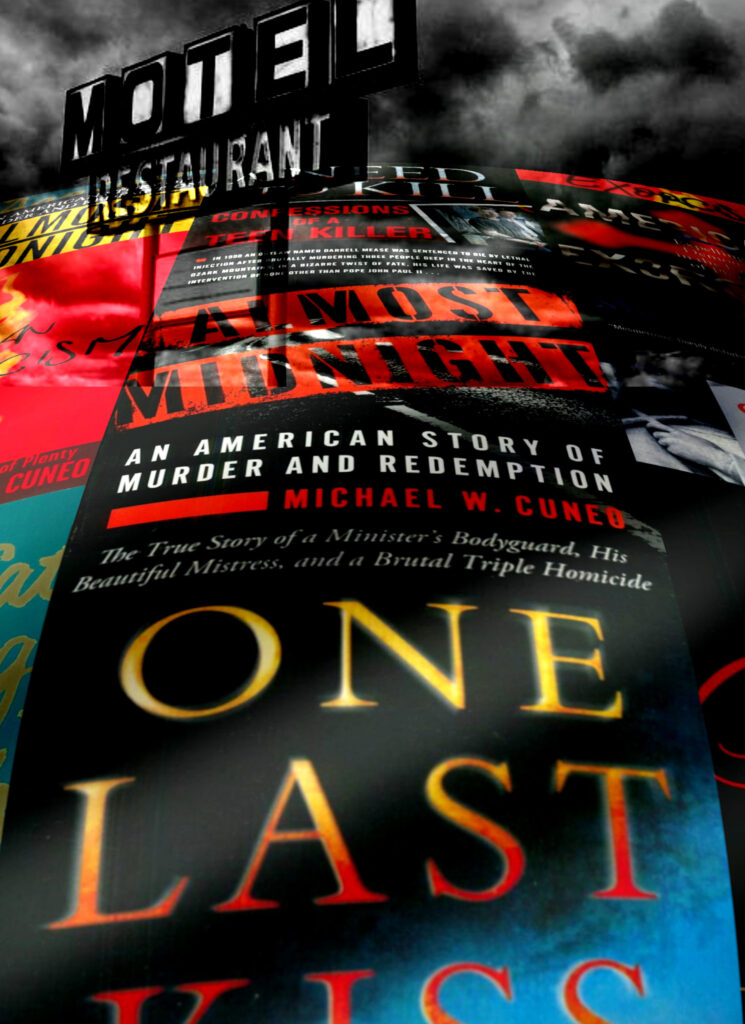
“Almost Midnight: An American Story of Murder and Redemption,” by Michael W. Cuneo. True (and truly disturbing) story of drugs and violence in Missouri’s Ozarks.
“Skinny Dip,” by Carl Hiaasen. Wetlands, crooks, wealth, a cruise.
“Destination: Morgue!” by James Ellroy. Searing nonfiction pieces make up for less interesting novellas.
The Atlanta Journal-Constitution


NONFICTION
● “Harvard Diary II: Essays on the Sacred and the Secular” by Robert Coles (Crossroad, $20). A Pulitzer Prize-winning author shares his observations. (April)
● “The Smoke of Satan: Conservative and Traditionalist Dissent in Contemporary American Catholicism” by Michael W. Cuneo (Oxford, $25). An assessment of right-wing Catholic groups and of militant anti-abortion activism. (May)
● “After God: The Future of Religion” by Don Cupitt (Basic, $20). The author traces the move from traditional belief to cynicism to faith after the so-called death of God. (May)
The Kansas City Star




THE TROUBLE with the “true crime” genre: Its frequent extremism.
On the one hand, some of its practitioners engage in lofty literary pretensions: Norman Mailer trying to turn The Executioner’s Song into “a true life novel,” or Truman Capote getting his facts not quite right as he seeks the prose summit in the pages of In Cold Blood.
On the other hand we find countless titles that come dangerously close to being sleaze. Typically, these are quickly written, sensationally promoted or laden with lurid photos. Think of James W. Clarke’s Last Rampage or Don Davis’ The Milwaukee Murders, re-released in paperback as The Jeffrey Dahmer Story.
So it’s always great to find a well-balanced exception, such as Michael W. Cuneo’s Almost Midnight: An American Story of Murder and Redemption, a true-crime yarn built upon journalistic prose and solid research.
This is a book from a New York and Toronto-based author who actually bothered to immerse himself in the daunting milieu of Ozark outlaws, backwoods meth labs and murderous impulses. In short, Cuneo, despite being an outsider, came to southern Missouri and got it right.
Almost Midnight chronicles the disturbing transformation of Darrell Mease. Mease was born in the late 1940s in Reed Springs, Mo., and his early life was rooted in Pentecostal religion, in the boyhood pastimes of hunting and fishing, in a lifestyle so squeaky clean that it didn’t even involve profanity.
As Cuneo writes, a tour of duty in Vietnam changed all that. When Mease returned to Missouri in the late 1960s, he came home as a young man beset by drug and alcohol problems. A turbulent marriage and a lack of any real career opportunities didn’t help matters.
Nor did the surroundings, nor the company Mease chose to keep. Cuneo’s depiction of Mease’s world is especially vivid:
“The Ozarks had always attracted outlaws, men and women who were out of sorts with mainstream society, who harbored deep grudges and had few if any bridges left to burn. The rough-and-tumble terrain, with its rugged bluffs, lost caves, and steep hillsides, afforded plenty of places for hiding out, digging in, making plans for that one last score, that one last run for happiness.”
By the late 1980s Mease saw that “one last run” as a partnership with Lloyd Lawrence, a man reputed to be setting up methamphetamine labs all over the hill country. Suffice it to say that the two men didn’t quite hit it off, partly because of Lawrence’s leering at Mease’s young girlfriend, Mary Epps.
Lawrence was no saint; because of his not-so-subtle threats, both Epps and Mease would fear for their lives — although in Mease’s case, part of the dread may have been based on his sampling of the meth, or “crank.” At any rate, the tension between the two men reached its peak in May 1988, when Mease hid out in the brush on Lawrence’s property, then shotgunned Lawrence, Lawrence’s wife, and the couple’s grandson.
Mease fled Missouri with Epps, and the couple spent much of their time in the American West, living as nomads, often down and out. When Mease finally was apprehended, he provided authorities with a videotaped confession.
Then things got weird.
In jail Mease turned to religion, but this was less a conversion than a return to the values imparted to him in his youth. Despite his 1990 conviction and death sentence, Mease’s faith convinced him he would not be executed.
He was right.
Mease was supposed to die in January 1999. That month Pope John Paul II, a strong opponent of the death penalty, visited St. Louis and pleaded with Gov. Mel Carnahan to spare Mease’s life. Only once had Carnahan commuted a death sentence, and that case had involved circumstances far more mitigating than anything Mease could bring to the legal appeals table.
But Carnahan granted the pope’s request. Mease’s sentence was commuted to life in prison without possibility of parole. Carnahan died the following year in a plane crash while campaigning for a U.S. Senate seat against John Ashcroft — and Missouri voters elected the dead man. Meanwhile, Darrell Mease remained incarcerated in Potosi Correctional Center, as he does today.
The story should end there — except that Mease’s faith seems to have no end. As Cuneo writes, Mease still believes he may be released from prison one day. Impossible? Consider Cuneo’s observation about how unusual the case already has been:
“Darrell Mease, one of the last true Ozark hillbillies, had become the first person in the history of the United States to have his death sentence commuted through the direct intervention of a religious leader from outside the country.”
Cuneo’s book, in addition to depicting southern Missouri so vividly, raises serious questions without presuming to know all the answers. Even death-penalty opponents would concede that mercy for Mease, while so many others have been executed, was arbitrary.
Gripping as it is, Almost Midnight has its shortcomings. The publisher has not seen fit to include an index. And, given the complex nature of the subject matter, a chronology would have been nice.
But the reading experience is undeniably potent, for Almost Midnight barrels along like a hot rod on a twisty Ozarks road. There are no photos here; Cuneo depends on his prose alone to provide the imagery.
And the author has kept up with how Missouri has changed; Cuneo’s observation that meth labs have gotten even more sophisticated, harder for law enforcement to detect (some of the labs are even mobile now) is sobering indeed.
Almost Midnight is a fast, furious read that leaves one plagued by disturbing thoughts every time one manages to pause before turning another page.

The New Yorker


By Mark Rozzo
IN THE years since William Friedkin’s 1973 horror extravaganza, “The Exorcist” – which was rereleased with considerable fanfare last year – the archaic rite of casting out demons has become more popular than ever. So argues the Fordham professor Michael Cuneo in his AMERICAN EXORCISM (Doubleday), a recently published history of the contemporary resurgence of exorcism and belief in demonic possession. Cuneo sat in on dozens of exorcisms, finding that these days the controversial procedure (typically scorned by Catholic officials) runs the gamut from Linda Blair-style “puke-and-rebuke sessions” to mellow suburban affairs attended by hot chocolate, cookies, and potato chips.
The Times (Trenton, New Jersey)



THE AMERICAN fascination with demons and their exorcism can be attributed to two landmarks of popular culture according to “American Exorcism: Expelling Demons in the Land of Plenty” (Doubleday, 314 pages, $24,95), Michael Cuneo’s examination of this surprisingly common phenomenon.
The first was William Peter Blatty’s bestselling 1971 novel “The Exorcist,” which was made into a blockbuster movie in 1973. A Washington Post article about an exorcism performed on an adolescent boy inspired Blatty’s heavily fictionalized account. The year was 1949, and Blatty, then an undergraduate at Georgetown University, became possessed by the story.
Next came the publication, in 1976, of Malachi Martin’s “Hostage to the Devil,” a lurid bestseller in which this former Jesuit priest described five contemporary case histories of possession and exorcism.
“Am I really suggesting,” writes Cuneo in his concluding chapter, “that the popular entertainment industry, with all its dreck and drivel, is capable of manipulating – actually manipulating – religious beliefs and behavior?”
In a word, yes.
Why, asks Cuneo, would we expect religious Americans to be any more immune to Hollywood’s charms than the rest of us? “The only surprise, in my view,” he continues, “is that scholars of religion in the United States have been so slow to make this connection.”
But the question remains: Do demons really exist? And does exorcism actually expel them? While Cuneo is more equivocal when it comes to these issues, let me just say that anyone who truly believes in demonic possession will find much to appreciate in “American Exorcism.”
Cuneo, a sociologist at Fordham University, spent two years studying exorcism ministries across the United States. He interviewed exorcists and deliverance ministers, as well as those who believed that they had been possessed by, then delivered from, evil. He witnessed the exorcisms of more than 50 people, as well as a number of group deliverances.
Apparently there’s no shortage of fodder for research these days. In New York alone, four Catholic Church-appointed exorcists have investigated approximately 40 cases annually of suspected possession since 1995. In America’s heartland, burgeoning charismatic deliverance ministries within Protestant sects have been casting out hoards of evil spirits from spirit-filled seekers since the 1980s. While most of us consider these rituals to be the domain of Catholic priests, Cuneo reveals that exorcism is embraced by many modern mainstream Pentecostals and evangelicals, as well. Indeed, sectarian nuances are many and complex, but Cuneo sorts it all out with sociological precision.
While no one levitated, broke out in “brandings” or morphed into a serpent before his eyes, Cuneo remains remarkably unwilling to declare it all a hoax. What he did – and did not – see makes for interesting reading, but what is more compelling is the case he makes for the potency of popular culture, the therapeutic value of a “placebo effect writ large,” and the simply brilliant proposition that exorcism could be considered a form of “alternative medical therapy for those who see demons, not cholesterol, not toxic particles, not environmental stress or genetic predisposition – no, not any of these, not primarily anyway – but demons, real glowering, hell-bent-on-evil demons as the major scourge of our time.” Given the American inclination to seek solace, if not illumination, through therapy, exorcism could certainly have its place in the bumper crop of contemporary treatments. Exorcism may be, says Cuneo, the “crazy uncle of therapies,” but therapy it is.
As its title suggests, “American Exorcism” is about the quintessentially American character of an ancient religious ritual. “Despite being cloaked in the time-orphaned language of demons and supernatural evil, deliverance was surprisingly at home in the brightly lit, fulfillment-on-demand culture of post-Sixties America,” the author observes.
Cuneo brings to his subject a delightful combination of respect, curiosity, irony and, not least, a humor that manages to be wry without being derisive. He has written one of the few books whose footnotes merit careful reading. This is sociology at its absolute best – rigorous field work conducted in the grand Chicago School tradition of participant and nonparticipant observation – and its findings are delivered with wit, wisdom and lucidity.
Booklist

Michael W. Cuneo ● American Exorcism: Expelling Demons in the Land of Plenty (Doubleday, $24.95)

By John Green
MICHAEL CUNEO’s passion for all things bedeviled led him to write this remarkable book, a sweeping study of exorcism in contemporary America. His hypothesis? The popularity of exorcism, especially of the difficult-to-attain Catholic variety, is due in large part to William Peter Blatty’s novel The Exorcist and the popular film of it.
Cuneo traveled the country, witnessing every variety of demonic expulsion, from official Catholic exorcisms to large meetings in which demons of lust are called out of evangelical Protestants. Cuneo’s point of view, “open-minded skepticism,” is in truth more skeptical than open-minded, but the exorcisms he saw offered little to gainsay incredulity. Written at an ironic distance that permits laughter at some of the more absurd exorcisms (e.g., a man exorcised because he sometimes disagrees with his girlfriend), the book reads like a novel. It is a wonderfully astute and readable dissertation on pop culture’s manipulation of religion.
YA/L: A fascinating study of demonology for teen fans of The Exorcist and Buffy.

Kirkus Reviews

Almost Midnight: An American Story of Murder and Redemption
A strong true-crime tale with disturbing noirish undertones and undeniable spiritual flair
AN ENGROSSING examination of an Ozarks triple murder and its strangely sympathetic perpetrator, who avoided execution via the pope’s intervention.
As in his American Exorcism, Cuneo methodically examines a tangled American subculture, rife with extremism and religious fervor. Here, he addresses the outlaw archetype that’s endured within southwestern Missouri culture, at odds with the milieu presented to the state’s Branson-bound tourists.
Darrell Mease was the most charming boy in Reeds Spring, Missouri, and his idyllic childhood bred within him the region’s strict Pentecostalism; yet Vietnam, failed marriages, and involvement in the Ozarks methamphetamine scene left him a fractured and paranoid man. Following disputes with feared local drug kingpin Lloyd Lawrence (whose ordinary lifestyle belied a brutal history, including the rape of his own daughters), Mease fled Missouri with stolen meth and with Mary Epps, whom he considered his true love; Lloyd then put out murder contracts upon both.
Cuneo argues that an unspoken code of Ozarks vengeance, developed in response to historically corrupt law enforcement, influenced Mease’s decision to return and settle accounts with Lloyd; in a shocking ambush, he shotgunned Lloyd, his wife, and handicapped grandson. After several months on the lam, Mease was captured and confessed in an attempt to protect Mary; following his 1989 conviction and death sentence, he experienced a jailhouse conversion, claiming that God would not allow his execution. Incredibly, the 1999 papal visit to St. Louis forced postponement of Mease’s execution date; after noting this, the Vatican indeed prevailed upon then-governor Mel Carnahan to commute Mease’s sentence to life. (Yet, Cuneo observes that Missouri’s pro-execution politics have since continued unabated.)
Cuneo is skillful at nailing down the elusive stories of warts-and-all heartland America; he does a fine job of untangling this complex affair’s ambiguities, in which idealized rural lifestyles collide tragically with the concentrated violence of both the drug war and state-sanctioned capital punishment.
A strong true-crime tale with disturbing noirish undertones and undeniable spiritual flair.
South Bend Tribune (Indiana)


The Post and Courier (Charleston, South Carolina)

Varieties of Satanic Experience
A review of American Exorcism: Expelling Demons in the Land of Plenty by Michael W. Cuneo. Doubleday. 314 pages. $24.95.
By Rodney Welch
MY SOLE experience with demonic possession came sometime in the early 1970s, when one of my Southern Baptist preacher dad’s many eccentric preacher friends came through town. This one was a big fellow named Winifred Worley, about whom I recall almost nothing except that he claimed to see several demons sitting on the shoulder of my brother Tom. Tom can’t recall now whether Worley said it was seven, or seven on each shoulder.
I never learned what became of Worley until reading American Exorcism, Michael Cuneo’s wide-ranging and rather sympathetic survey of people who occupy this shadowy corner of religious life. The late, “now largely forgotten” Worley plays quite a role in the book, as something of a trailblazer in bringing “deliverance ministry” into American Protestantism. Where mainstream preachers, such as my dad, generally regarded casting out demons as sensationalistic, backwoodsy, tent-revivalist stuff that belonged to a more primitive past, Worley began in late 1970 “performing exorcisms, wild, rambunctious affairs that sometimes raged on well past midnight.” And he did it all before The Exorcist hit the theaters – before, that is, the modern history of the subject really began.
As Cuneo charts it, William Peter Blatty’s novel and subsequent film hit something of a nerve in the American psyche; people “who might not otherwise have even considered the possibility that their problems were demonic in nature now had positive cultural incentive for doing so.” After the movie’s release, demon-spottings and demon-busting soared. Satanism, either in fact or in the popular imagination, took hold in America. In the paranoid culture of the 1980s, it figured into murder cases and rock lyrics, as well as one custody battle, “recovered memory” incident and daycare center case after the next.
Cuneo, who attended some 50 exorcisms in the course of his research, details the different ways this strange type of work is practiced across the Christian spectrum. Catholics, of course, have had a ritual for the expulsion off demons since 1614, but the church generally finds it an embarrassment and those who practice it, at least until recently, have tended to do so on the sly. For charismatic Christians – which include a variety of multi-denominational believers who embrace a “spirit-filled” life that includes speaking in tongues and faith-healing – possession and exorcism are all about “affliction” and “deliverance.” Here, the focus isn’t so much on demons who enter the body of a hapless lost soul as it is on waging war with the demons who torment the faithful. According to the people in the deliverance side of the house, demons may well be something you’re born with – they even talk of “transgenerational” evil that you inherit from your forebearers. There’s even one Christian psychotherapist in the book who employs something called a “genogram,” a genealogical tracking chart that helps determine where the demons first began to infect the family tree.
Groups differ as to the best way to cast out demons; for some it’s a sloppy public sideshow, for others a matter of prayer, devotion, and serious therapy. Do you let demons curse and scream, much as they did when they inhabited Linda Blair, or do you “bind them,” telling them to shut their blasphemous mouths in the name of the Lord? For some exorcists, all the shrieking, screaming, and puking are a vital part of the ceremony: “a certificate of authenticity, the surest, most visceral proof that demons – real spitting, jeering, profanity-addled demons – were actually being engaged in combat.” For others, letting Satan take the spotlight is just a drain on everyone’s time.
For people of a purely rationalist bent, all of this will likely seem quite mad, and people who see demons may not appear much different from people who see UFOs. But part of the reason for our lingering interest in both areas is that fairly serious people share the stage with outright kooks. How much of the truth is “out there,” and how much is the work of an overactive imagination?
Cuneo, not surprisingly, says that in all his time amidst the demons he never saw any head-spinning, levitation or fleshly graffiti, but he doesn’t dismiss exorcism out of hand either. In cases, it has a “placebo effect” for certain ills, regardless of whether demons were actually involved.
American Exorcism makes for an absorbing social history of a contemporary phenomenon, and our own continued fascination with the devil’s work.

Alibi (Albuquerque, New Mexico)

American Exorcism: Expelling Demons in the Land of Plenty, Michael W. Cuneo (Broadway Books ● Paperback ● $13.95)
By Steven Robert Allen
NEW OUT in paperback is a surprisingly open-minded look at a fun hobby that’s almost as popular now as it was back in the Middle Ages. No, I’m not talking about bloodletting or self-flagellation. I’m talking, of course, about exorcism. Cuneo goes several steps beyond mere anecdotal accounts of this widespread practice. He shows the relationship between these bizarre rituals and popular culture, exposing an aspect of modern American life that’s almost too freaky to believe.
The Tampa Tribune

Catholics Fear Implosion
The Smoke of Satan: Conservative and Traditionalist Dissent in Contemporary American Catholicism. By Michael W. Cuneo. Oxford University Press. 214 pages. $27.50
By Maggie Hall
THERE ARE pockets of the faithful who claim that the Roman Catholic Church went to hell in a handbasket after Vatican II, Pope John XXIII’s council to let fresh air into the sometimes-musty corners of the church.
The Tridentine Mass – now, there was spirituality, according to the anti-Vatican II set. Aging baby boomers remember Latin Masses intoned by a priest whose back was to the congregation.
Traditionalists eschew the folk Masses, Communion received in the hand and nuns without the wimples and heavy habits of long ago, all of which Vatican II brought in its wake.
Some dissenters are content to drive out of their way to attend Latin Masses, but others take their post-Vatican II opposition much more seriously. A diehard enclave in the Northwest has installed its own pope in opposition to John Paul II, whom they see as an agent of Satan.
In “The Smoke of Satan,” author Michael W. Cuneo distills conservative dissent in Catholic America into three groups, each of which attacks the changes from Vatican II in contradicting ways.
Catholic conservatives are moral militants who are still loyal to all of the Holy See’s teachings; they’re diehard in their anti-abortion stance and find commonality with other Christians in the Moral Majority.
That proximity to other Christians and their alliance to Rome horrify separatists, who might be called the lunatic fringe of Catholic dissent. Catholicism as it existed since St. Jerome was killed by Vatican II, they say. It’s up to them to purify the faith by dissociating themselves from things as they are. They form their own communities shut off from society; some ordain women and married men as priests.
Marianists, on the other hand, rely on visionaries – who are usually working-class women – to bring them dire warnings about the state of the world directly from Mary, the mother of Jesus. Their faith is grounded in the messages of the visionaries, who predict global destruction unless the world dedicates itself to Marian principles.
To the Catholic faithful, Mary is everywhere, even on the windows of a finance building in Clearwater.
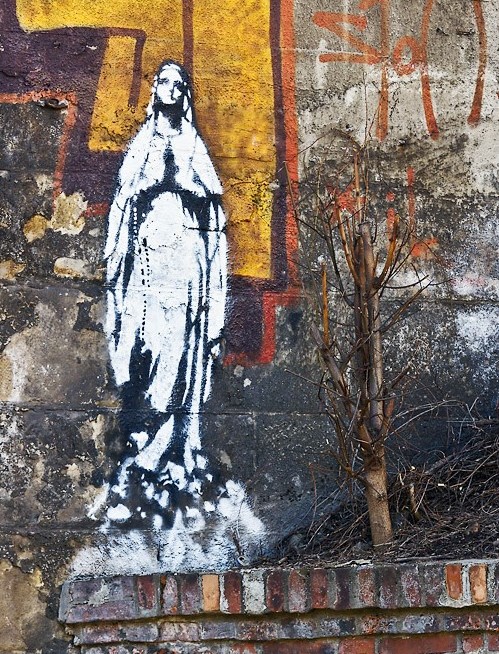
The cult surrounding the late Veronica Lueken is Cuneo’s focus in the Marianist chapters. He interviews the still-faithful and the fallen away, who were mesmerized by the New York housewife’s conversations with Mary at Flushing Meadows, a park in the shadows of Shea Stadium in Queens. When Lueken drew groups to the grounds of her parish church, it took a denunciation from the pastor to drive them away. Lueken died in 1995, but her “Baysiders” continue to gather at Flushing Meadows to pray and discuss her transcribed messages.
If Lueken is the Marianist Madonna of dissent, then maverick priest Nicholas Gruner is the movement’s testy St. Paul. His Fatima Crusade group continues to press the pope to consecrate Russia to Mary, which the Vatican says it performed in 1942 and 1982.
According to Gruner’s flock, a consecration following the instructions communicated by Sister Lucia, the last surviving Fatima visionary, hasn’t been done to their satisfaction.
They claim that satanic elements in the Vatican are preventing this from happening, and the fate of the world is at stake.
One group decries conservatives who picket abortion clinics because they sing Protestant hymns, which they feel corrupts the Catholic faith. Another sect founder admits that his opposition to Rome puts him closer to traditional Protestant beliefs than to Catholicism.
Cuneo handles his interviews with great restraint, giving every point of view its voice. “Baysiders” who left the movement in disappointment over Lueken’s lifestyle and former members of the more radical sects balance the powerful personalities of the founders of the movements he profiles.
Cuneo’s treatment of a “jihad”-like Catholic underground that uses pamphlets in place of car bombs is not only enlightening but necessary. The average Catholic sitting in the pew on Sunday may not realize that Vatican II did more than change the language of the Mass.


Book Magazine

Michael W. Cuneo ● American Exorcism: Expelling Demons in the Land of Plenty (Doubleday, $24.95)
By Chris Barsanti
IF THERE were ever any question about the power of pop culture to influence people’s behavior and beliefs, it is put to rest by Michael Cuneo’s provocative and frightening book on exorcisms in modern-day America. Once an almost forgotten Roman Catholic rite, exorcism – the act of casting demons out of the supposedly possessed – was reintroduced into the popular imagination in part by the 1973 horror film The Exorcist and the hysterical 1976 bestseller Hostage to the Devil: The Possession and Exorcism of Five Americans. Since then, according to Cuneo, thousands of people have used demonic possession as a way to explain mysterious illnesses and mental problems, much to the chagrin of the church, which usually tries to distance itself from the practice.
Cuneo paints a broad portrait of an America where rogue Catholic priests and even Protestant (mostly Episcopalian and Pentecostal) ministers routinely perform exorcisms (called “deliverances” by non-Catholics). His research takes him to some fascinating places where ancient religious dogma meshes with New Age therapy. He’s so worried about not being judgmental, however, that he lets most of these self-styled spiritual warriors (the vast majority of whom seem little more than evangelical shysters) off the hook too easily.
Kirkus Reviews
Michael W. Cuneo ● The Smoke of Satan (Oxford)
A THOUGHTFUL, detailed exploration of three small but growing fundamentalist groups within post-Vatican II American Catholicism. The sweeping changes instituted by the Church in the 1960s were not greeted with equal enthusiasm by all American Catholics: A small but highly vocal minority felt the Church had impulsively abandoned its defining precepts. Cuneo (Catholics Against the Church) examines several distinct groups that have emerged from the “crisis of identity” caused by change: moral conservatives, including the militant late-20th-century crusaders against abortion; Catholic separatists, who have withdrawn from the Church and created their own isolationist communities; and Marianists, who seek guidance from the apocalyptic messages of the Blessed Virgin’s miraculous appearances.
Of these, the last two are perhaps the least understood. The conspiracy theories of separatists—who believe that John Paul II is a false pope, selected by communist forces intent on infiltration—are fodder for ridicule, but Cuneo never mocks his subjects. Rather, he seeks to understand separatism’s origins in the seeming vacuum of authority created by Vatican II, which liberalized the priesthood, granted power to the laity, and acknowledged nonpapal sources of truth. Similarly, the author places the Marianists in a context of the demythologization of Catholicism after the Council. Marianism explicitly rejects the deep-sixing of miracles, affirming a divine control of human history.
This is a winning ethnography of some unusual religious sects.
Catholic New Times

Cuneo presents balanced view of abortion issue
By Gerald J. Stortz

Michael W. Cuneo. Catholics Against the Church. University of Toronto Press
MICHAEL CUNEO teaches sociology at New York’s Fordham University. Previously, he co-authored (with Anthony J. Blasi) Issues in the Sociology of Religion.
Catholics against the Church is a rarity in the literature dealing with the abortion issue. The book is a finely tuned, academically sound, sociological study, and despite Cuneo’s protestations that it “is a historical investigation only in a quite secondary sense,” it is also a detailed chronicle of the anti-abortion movement in Toronto.
The book is noteworthy on two other grounds. Despite the fact that Cuneo lives and works in New York, he obviously has Toronto roots and understands the context about which he writes. The study is also balanced with representatives on both sides of the issue allowed to debate their case.
Cuneo has structured his work in a very traditional fashion, dealing with a brief history of the anti-abortion movement, the relationship between church hierarchy and movement, and a four-chapter analysis of anti-abortion protest.
In the early chapters, there are two things which stand out. The first is Cuneo’s reminder that, despite media characterizations of anti-abortion protesters as “Catholic,” the movement is not only multi-denominational but includes agnostics and atheists.
The second is the difficult position in which the Catholic hierarchy in general (and Cardinal Emmett Carter of Toronto in particular) finds itself. Although Cardinal Carter does not gain my sympathy on all issues, in this case he was in a no-win situation.
If he failed to speak out against abortion, the militant Catholic wing of the movement chastised him for lacking moral fiber. But whenever he did speak out, the liberal wing (which also included a good many Catholics) couldn’t help but cringe. In Canada’s pluralistic culture, the last thing they wanted was for the anti-abortion cause to be too closely identified with Catholicism.
This sometimes apparently schizophrenic relationship between protesters and church hierarchy consumes the rest of the book and renders it as important as it is.
Perhaps Michael Cuneo’s most valuable contribution comes in chapters 5 through 7. In “Varieties of Anti-Abortion Activism,” he takes pains to point out through biographical profiles that there is no typical pro-lifer; that activists come from a variety of educational, socio-economic and political backgrounds.
Particularly fascinating is Cuneo’s description of Catholic Revivalists, a group which equates a “soft” stance on abortion with the degeneration of the Canadian Catholic church, epitomized by the emphasis in recent years on social justice, which seems more concerned with mundane matters than with spiritual.
One must admire Michael Cuneo for writing a provocative, often disturbing work.
Daily Chronicle (De Kalb, Illinois)


Michael W. Cuneo ● American Exorcism: Expelling Demons in the Land of Plenty (Doubleday, $24.95)
‘American Exorcism’ a very interesting, compulsively readable book
By Chris Rickert
AUTHOR Michael Cuneo’s driving thesis in the titillatingly titled “American Exorcism: Expelling Demons in the Land of Plenty” is simple enough.
Exorcism and its less ritualistic younger sibling, deliverance, are thriving in the technologically advanced, secularist culture of turn-of-the-century America, he says, thanks in large part to the popular media’s fascination with the subject and a malleable population eager for new-age healing and alternative therapies.
For Cuneo, William Peter Blatty’s 1971 novel “The Exorcist,” along with the 1973 movie of the same name, was key to the rebirth of this ancient practice. And in something of an ethnographic tour, he goes from coast to coast detailing all the different forms exorcism has taken over the past 30 years – from the formal exorcism performed by the Catholic priest, to mass deliverances in which entire roomfuls of people writhe and blaspheme and wrestle with lay ministers bent on forcibly evicting scores of demons.
That said, Cuneo takes great pains to leave the door open to the possibility that Satan is real, his minions are frequently cavorting among us and exorcisms really do work. The fact that he never reports seeing any credible evidence of any of this in the more than 50 exorcisms he attended might just mean he was continually at the wrong place at the wrong time.
What the reader is left with then is the age-old, logic-defying problem of faith. As a good academic, Cuneo cannot bring himself to abandon his well-honed objectivity, damn the relativistic posture of the modern university, and declare these people nutcases.
Which is fine. The argument that “just because you can’t see it, touch it, hear it or feel it, doesn’t mean it isn’t there” can become tedious – after all, anyone of us could simply be a brain in a jar, hooked up by some mad scientist to electrodes that merely make us think we eat, talk, live and breathe. But just as tedious is 300 pages of slamming an easy target.
“Some of the people I met during my research claimed to have experienced significant improvement in their personal lives as a result of undergoing exorcism,” Cuneo writes. “Their depression lifted, their fears fled, their inner torments dissipated.”
Wonderful. More power to them.
“American Exorcism” is a very interesting, compulsively readable look at a phenomenon that most people probably weren’t very aware of, questions about the existence of the Antichrist aside.
West Coast Review of Books
Michael W. Cuneo — American Exorcism (Doubleday, $24.95)
By B.W.F.
“IT’S ALL IN YOUR MIND!” would be a succinct summary of Michael Cuneo’s position on demonic possession. After attending fifty exorcisms, twenty of them the ones so sparingly performed by Roman Catholic priests, he has not yet seen any phenomenon that he can explain only by evoking supernatural powers. However, he is a professor of sociology and a skeptic – what the para-psychologists would call a goat – to delight Isaac Asimov and Randi: when every other witness sees the subject levitate, he sees nothing.
Although exorcism, in the strict sense, is a Roman Catholic ritual, the more charismatic Protestant faiths have a corresponding service called a deliverance. Cuneo reports that in some churches numerous believers experience deliverance simultaneously (but, correspondingly, the sufferers may require multiple treatments). However, there is obviously a temptation for persons to say, “The devil made me do it,” rather than admitting sin and undertaking penitence. And, as Cuneo notes, it is entirely possible for the minister to actually create the condition he, or she, is curing – vide the innumerable cases in which child abuse is remembered only after therapy is undertaken.
Cuneo finds it striking that demonic possession should have blossomed after the film The Exorcist and the novel Hostage to the Devil appeared (instead of the media only following behind the popular culture). But readers familiar with C.S. Lewis and his great classic The Screwtape Letters will see that this is reasonable indeed: the devil’s modern strategy of pretending not to exist allowed him to succeed in making so many conquests – but only until it was exposed. The philosopher Pascal pointed out that, because one cannot prove the non-existence of God, the safe wager is to behave as if He exists: correspondingly, the safe course is to assume that the devil can indeed possess souls.
Cuneo has a mastery of language that renders his work a pleasure to read, e.g., “American Catholicism probably has more bona fide exorcists at its disposal today than at any given time since the invention of color TV.”
While this book is no doubt intended for the general reader, there are ample references for anyone wishing to follow up the (gruesome) details.
The Christian CENTURY


Catholics Against the Church. By Michael W. Cuneo. University of Toronto Press, 288 pp., $40.00; paperback, $16.95
THIS BOOK is important both to readers in Canada, which is embroiled in a tense abortion debate, and in the U.S. Cuneo takes an almost absolutely noncommittal stand on the morality of abortion, and then applies social-scientific tools and good powers of observation to look at Canadian Catholicism.
No, opposition to abortion did not unite Canadian Catholics – anything but. Activists to the right make antiabortion the test of orthodoxy; those to the left insist on choice. Between them are church elites, including most bishops, priests and nuns, who “treat the issue with a circumspection bordering on avoidance.”
Cuneo’s findings show how Canadian Catholicism is in disarray, and how the abortion issue adds to the confusion. Indeed, it exposes the futility of hard-line and the precariousness of soft-line Catholicism as it resists or yields to modernity, pluralism, secularization and the like.
Neither Catholics nor people on either side of the abortion issue can take cheer from this study; it may alert other churches in Canada and in other nations. And it will shatter stereotypes.
America

Book Review: The Smoke of Satan by Michael W. Cuneo (Oxford)
By Martin R. Tripole
‘dissent (di sentﹶ ), v.i. 1. to differ in sentiment or opinion, esp. from the majority’
ꟷ Webster’s College Dictionary
MICHAEL W. CUNEO has given us a witty, even hilarious, and sometimes frightening study of the inner workings, the theological convictions and the major gripes of three different “factions” on the Catholic right: conservatives, separatists/traditionalists and apocalypticists and mystical Marianists.
I question whether it is fair to group the first with the last two (should one rank the reasonable alongside the eerie and kooky?) or to call them components of an “underground” church, when they all seem evidently above-ground. But Cuneo’s analysis of their views tries to be balanced. While he accepts the criticism that the post-Vatican II church has given us “an age of deadened ritual and flaccid theology” that spurs on the right, he also makes it clear he finds much of what the right supports to be lunacy.
What precisely is the cause of the religious right’s anguish? All of these factions are united in their rebellion against the equation of Catholicism and its countercultural values with the laissez-faire secular humanism of our liberated American society. Nearly a century after Pope Leo XIII’s condemnation of Isaac Hecker’s Americanism, Hecker’s brand of American Catholicism has come to dominate. And with it has come disintegration and disaster in just about every aspect of Catholic life.
There are significant distinctions among the three factions. For the conservatives, the aftermath of Vatican II has led to a crisis of morality, rooted in the widespread contraceptive mentality that rejects Humanae Vitae and makes abortion inevitable. There is also a crisis of theological identity. Theologians have traded a deposit of revelation rooted in the transcendent for the immanent possibilities of human life. And, most importantly, there is a crisis of authority; the intellectual elites now rule and personal conscience is master. The conciliar bishops have unwittingly catered to these crises due to their lack of spine. It is the task of the dedicated laity to restore the faith. The answer: Accept Vatican II and, by “public witness” against the inroads of abortion, keep genuine faith alive and rejuvenate the church.
The separatists are deeply divided among themselves, as schism after schism occurs, but conspiracy theories abound. False popes (e.g., John Paul II) have destroyed the church with heretical teaching, while the real pope is either imprisoned or the See of Peter is presently vacant. Some groups, such as the sizable Mount St. Michael community in Spokane, Wash., manifest certain Catholic militia tendencies toward the U.S. Government, which is viewed as trying to overthrow religion and establish a single world government. Their goal is to restore Christendom and the Tridentine Mass while advocating strict isolationism from a hierarchical church that is evil and irreformable.
Finally, there are the apocalypticists and mystical Marianists. The former propose three stages of chastisement and peace leading to a new Christendom ruled by Pope Gregory XVII, otherwise known as Father John Gregory of the Trinity, current head of the Apostles of Infinite Love. But this utopia will lead, unless their warnings are heeded, to a new period of chastisement and eventually to war and world destruction. There are also the Fatima Crusaders, whose goal is to publish the Third Secret of Fatima and have Russia consecrated to Mary – both with the approval of the bishops throughout the world. According to the Fatima Crusaders, Satan is still at work in the threat from Russian Communism, and unless the world repents, we are doomed. In addition, there is the movement of Veronica Luecken in Bayside, Long Island, where prayer vigils and messages from the Virgin Mary electrify countless thousands.
What is most amazing about the separatists and apocalypticists is the utterly bizarre nature of their forebodings of the end of time and the incredible depth of their convictions in strange, fantastic scenarios. Their leaders are scary individuals. In Veronica’s case, you either do what you are told or you are condemned to hell.
Cuneo has done his homework. His book is filled with direct data from personal interviews he conducted with the leaders of all the groups he analyzes (I counted at least 18). He makes us aware for the first time of the insidious nature of many of those seemingly innocent newsletters we receive from right-wing groups apparently in sympathy with the church. Sparkling with irony, he provides a clear picture of the deep divisions occurring in the right-wing of the church. At the same time, his reflections on their sinister operations leads to a disturbing question: How far will these divisions go, and when will they cease?
The Smoke of Satan is a cautionary tale containing an important lesson.

Times of Acadiana (Lafayette, Louisiana)

Exorcisms, Demons, and American Culture
By Rob Hardy
The movie, The Exorcist, brought exorcisms out into the open. Were the demons just waiting around or did the movie cause enough people to start believing in the possibility of demonic possession to cause a social movement? American Exorcism: Expelling Demons in the Land of Plenty takes a look at these questions, looks at how various religions handle exorcisms, and wonders what, if anything, is real.
HAVE YOU SEEN SATAN LATELY? Seen any effects of demons? Maybe not, but you have much better chances of seeing them now than prior to 1973, which was when The Exorcist came out. Then in 1976, Hostage to the Devil, a former Jesuit’s account of heroic priests battling demons, became a bestseller. Before then, well, yes, there were exorcisms. Jesus is supposed to have done them, and told his followers to do them, so one would think that we are only riding our part of a 2,000-year-old tradition. In America, though, exorcisms were essentially nonexistent until the mid-1970s. Could it be that all the demons were waiting on Hollywood to release a movie they could be proud of before they started infesting everyone?
Author Michael W. Cuneo is an “open-minded skeptic,” and he doesn’t find that this is the best explanation. In American Exorcism (Doubleday), he offers the disturbing idea that the popular entertainment industry has manipulated religious beliefs and behavior. He explains that not everyone will see The Exorcist and be compelled to look up his local exorcist for treatment, but with millions seeing it, only a small percentage need to start taking exorcism seriously before it becomes some sort of social movement.
It is a movement with plenty of people behind it. It seems that there are over 500 evangelical ministries devoted to casting out demons. The Vatican, which had a recent history of frowning on the loud ravings of “the possessed,” is appointing official exorcists for archdioceses which never had them before, and non-official exorcist-priests are being sought by those convinced it is the only way to get better. You may have to look around for someone to give you an exorcism, but it should not be too hard to do, and you can even find a particular style of exorcism that best suits your tastes.
There is the official Roman Catholic version, the sine qua non of exorcisms, that is featured in movies and whose enthusiasts get the most time on talk shows. You may not get anywhere asking your parish priest for such a service, but there is a growing number of official Catholic exorcists and there are also rogue priests who perform exorcism in defiance of church rules. Cuneo finds the official Catholic version quite beautiful.
A charismatic service might be more to your liking, and certainly more readily found. Cuneo, who has attended many types of exorcism, reports seeing a gentleman freed of the demons of shame, rejection, and sexual perversion, with no drama other than some coughing and jerking of the head. “The whole business is orderly and efficient,” Cuneo writes, “a calm, controlled, almost decorous procedure.” Deliverance from demons came into charismatic churches three decades ago and has increased in frequency. It is a combination, Cuneo writes, “of primitive shamanism, backwoods Pentecostalism, and middle-class psychotherapy.”
There are charismatic churches that abhor the procedure, but casting out demons seems to fill a need for a large number of people. One can cast out demons of depression, alcohol dependence, or lust. Or even those of a particular religion, such as “demons of Roman Catholicism.” (There is no mention in the book of Catholic exorcists expelling demons of Protestantism.) Those who are exorcised can avoid blame for whatever naughtiness might have come before (“The devil made me do it!”). They can get rid of their problems quickly with validation from others. Exorcism is thus oddly consistent with various New Age therapies on the contemporary scene.
If you are looking for something more dramatic, you might turn to what Cuneo calls the “rough-and-ready school” of exorcism. Those being exorcised sometimes engage in fighting, swearing, and vomiting. In one church auditorium where Cuneo witnessed this sort of spectacle, there were ample supplies of paper towels and garbage bags for cleanup. After an hour, the group (quite a few people were being freed of demons simultaneously) broke for refreshments, and soon thereafter they started up with the exorcisms again. When the lead exorcist announced that time was up, the demons stopped misbehaving and a calm fell over the auditorium. “The demons at this gathering,” Cuneo writes, “communicate along rather quaint gender lines. When acting out in the men, they blister the paint with foul language, but with the women they mostly restrict themselves to screaming, shrieking, and crying out such innocuities as ‘I hate this workshop’ or ‘Shut up!’ In addition to cooperating with the staging of the performance, in other words, the demons seem respectful of local norms of public comportment.”
Other exorcists regard dramatics of this sort with disdain. All that is needed, they say, is to bind the demons beforehand. This is done by commanding them in the name of Jesus Christ to keep their peace, which has become practically obligatory for Catholic and Episcopal exorcists, not least of all for the purpose of saving on the cleaning bills.
Cuneo says that exorcism may indeed have positive therapeutic benefit, if only by virtue of the placebo effect. He is also clear that it may result in death. Enthusiastic exorcists have pummeled and suffocated those they thought were possessed.
On the big question, Cuneo remains agnostic. Does exorcism actually drive out demons? He claims that he can’t answer this definitively but concedes that “nothing reached out and grabbed me by the throat.”
“At the exorcisms I attended,” he writes, “there were no spinning heads, no levitating bodies, no voices from beyond the grave. (There was plenty of vomiting, no question about it, but nothing more impressive than what you’d probably catch most Saturday nights out behind your local bar.)” He was present when others also in attendance saw bodies levitating, but he says that, “People tend to be so keyed up during an exorcism, so eager to sink their fingers into something preternatural, that they easily convince themselves they’re seeing, hearing, or feeling things that simply aren’t there – not really there – to be seen, heard or felt.”
It is clear that Cuneo has tried to be fair throughout his wittily-written and entertaining book. But the evidence he provides suggests that there is little in the world of exorcism that is better explained by demons than by simple human idiosyncrasy.
Kirkus Reviews
Michael W. Cuneo ● American Exorcism: Expelling Demons in the Land of Plenty
An engaging and detailed document of a provocative subculture
AN evenhanded assessment of a volatile subject: demonic possession and expulsion among modern-day Americans.
Cuneo (The Smoke of Satan; Catholics Against the Church) incorporates sociological and anthropological viewpoints into his exploration of the religious underground’s promotion of exorcism as a necessary service—something that Catholicism has publicly forsaken.
The popular fascination with demonic possession is easily traced to William Peter Blatty’s Exorcist; despite the effort to ground his work in a real 1949 incident, the movie version (recently re-released) fit well within a time of cultural hysteria that culminated in 1980s-era pursuits of Satanic cults (embodied by heavy-metal fans and day-care centers).
Cuneo adroitly defines contemporary exorcism reality as a manifestation of the “therapeutic ethos of the prevailing culture,” in that participants are able to blame personal ills, from anxiety to promiscuity and substance abuse, on infestation by demons.
He discusses (and interviews) many significant figures who have promoted exorcism rituals across diverse faiths, developing insights on how the “down and dirty” Pentecostal deliverance ministries differ from relatively conservative Episcopal charismatics, and recent efforts by the Roman Catholic church to authorize priest-exorcists.
Many practitioners the author encounters are appropriately skeptical about it all, yet seem to succeed in addressing the moral turmoil of their clients through these rituals (indeed, Christian psychotherapists are involved in the exorcism movement). Some of exorcism’s most prominent promoters, though, such as ex-priest and Hostage to the Devil author Malachi Martin and “self-styled psychic sleuths” Ed and Lorraine Warren (of Amityville fame), seem dubiously reliable at best, but are hugely influential regarding popular ideas about the occult.
Cuneo takes some delight in depicting earnest Middle Americans vomiting, cursing, and writhing in carefully conducted rituals, but he admits that he’s encountered little that evoked the dark netherworld of honest-to-God possession.
An engaging and detailed document of a provocative subculture, in a study that will neither confirm nor confound the reader’s demonic fears.
Hartford Advocate

Deliver U.S. from Evil
Exorcisms, by any other name, are booming in America
By Gus B. Hogere
AS IF we need any more reasons to be freaked out about religious zealots from beyond our borders, along comes Michael W. Cuneo to jolt the green vomit out of us right here in our own backyard, with American Exorcism: Expelling Demons in the Land of Plenty (Doubleday, $24.95). Cuneo has researched and written extensively about America’s religious underground, particularly the fringe who seldom get scrutinized until they shoot an abortion doctor, fornicate with children or – as has happened in recent days – send anthrax hoaxes to Planned Parenthood offices.
Cuneo’s last book, The Smoke of Satan, focused on a group of Catholic fundamentalists who’d give the Taliban a serious run for their money. The Boston Globe shuddered at Cuneo’s revelations, calling his subjects a “bizarre and disturbing subgroup, whom even faithful Catholics would have a hard time embracing.”
This time out, American Exorcism examines an arguably more benign faction. These are the “hero-priests” who perform exorcisms. Oh, you thought exorcisms were as dead as the Latin Mass? Think again. They are a booming business. Primarily responsible for that boom among Roman Catholics is a Dominican priest named Father MacNutt (oh, behave), but there has been an equal surge of exorcisms – called “deliverances” – among Protestant evangelicals, sparked by a 400-pound Texan named Win Worley.
Most of the exorcists in Cuneo’s book are affiliated with the Catholic Church, yet only a handful are officially appointed by the various dioceses. They have in common one thing: They long for the days before the Second Vatican Council of 1962-65. These “maverick priests,” according to Cuneo, “inhabited the right-wing fringes of American Catholicism. Distressed by the rapid modernization of the church that was taking place – and especially by the declining fortunes of the traditional priesthood – they derived a perverse satisfaction from the dramatically increased reports of diabolic possession that resulted from [William Peter] Blatty’s novel and film [The Exorcist, of course, in 1973].”
Exorcism was a medieval holdover the Church had hoped was a relic of the past, but with The Exorcist, followed by Malachi Martin’s book, Hostage to the Devil, as well as the Amityville “horror” (wherein the ghosts were busted by Connecticut’s own Ed and Lorraine Warren), demon possession made a comeback.
It was, at that point, monkey see, monkey do, as hundreds of exorcists began plying their trade. According to Cuneo, they now have more work than they can handle.
To have demons driven out by a minister is no longer the prerogative of snake-handling Holy Rollers. Exorcisms are offered at “deliverance ministries” by “charismatic” ministers (“charismatic” has replaced the po’-white connotations of “Pentecostal”; likewise, “speaking in tongues” is now “glossolalia”). Group exorcisms have been incorporated into faith-healing ministries, wherein a roomful of people grovel on the floor, shout obscenities and vomit into plastic buckets. Exorcism is even being plied by “charismatic psychologists” as a form of therapy.
The mainstreaming, even gentrifying, of exorcism is primarily the result of its having gotten the thumbs-up from M. Scott Peck, whose People of the Lie insisted that evil does exist in the world, and can take demonic form and inhabit individuals. Indeed, before one can even approach exorcism seriously – that is, not to dismiss it as the ravings of lunatics – one has to decide whether one believes Peck’s sober assertions. What about non-Christians? Can they be inhabited by the same demons? Were the Islamic terrorists “evil” and, thus, inhabited by demons? And so on. It’s a bigger issue than it might first appear, partly because many of these exorcisms – according to practitioners and even the skeptical Cuneo – appear to be effective, at least temporarily. Cuneo writes, “deliverance [ministers] might not actually be expelling demons (my evidence on this score is far from conclusive), but this doesn’t mean they’re not making some tangible difference in their clients’ lives. In the hands of some of its practitioners, deliverance might very well possess positive psychotherapeutic value.”
Therein lies the rub. Most exorcists are right wing; their definition of “demons” includes feminism, homosexuality and open-mindedness in general. Because they also serve otherwise helpless people in the trappings of the church, the question is begged: Is it really that far a leap from group exorcisms to Jim Jones or David Koresh? The potential for abuse is, in fact, so obvious it’s astonishing the National Institute of Health has not interceded (given the faith-based climate of the Bush Administration, don’t expect this to happen on his watch). It would not surprise this reviewer if the insurance industry – smelling profits – were to further erode already paltry mental health benefits, while underwriting the cost of exorcisms. Depressed? Suicidal? Psychotic? Sex mad? Can’t stop eating? Cat got your tongue? Not to worry. Get an exorcism!
Exorcisms come in many flavors, but they all act like enemas for the soul or electro-convulsive therapy without the juice. Someone is said to be possessed by the Devil or more nebulous “demons,” and the exorcist is summoned to smoke it/him/them out. Cuneo personally attended 50 exorcisms, even interceding in one that became physically threatening. He interviewed participants and took testimony about other exorcisms from people he considered reliable witnesses (including one during which an obese woman levitated, turned her head 180 degrees and stuck out her tongue down to her knees). Because he is non-judgmental, Cuneo strikes a balance between journalistic integrity and humane concern, a perspective not unlike the one adopted by C.D.B. Bryan or John Mack in their investigations of extraterrestrial encounters.
Something, in other words, did possess these people. Whether it was the Devil his-big-bad-self, demons or just gas in the tummy, the idea was put in the victims’ heads that it was demonic possession. While less sympathetic observers might posit that it was simply over-exposure to religious fanatics, the ultimate danger of this readiness of half-cocked clergy to lay on hands is that it circumvents not just the church, but the law and medical ethics.
Some of these “possessed” souls are mentally ill and exorcism, often tacitly coerced, only exacerbates their condition and puts them in danger. Thus, some exorcists should not just be investigated but prosecuted.
Cuneo concludes: “The real curiosity isn’t that exorcism is practiced in contemporary America, but that it isn’t practiced far more widely. It would be difficult, after all, to imagine a better deal. Whatever one’s personal problem – depression, anxiety, substance addiction, or even a runaway sexual appetite – there are exorcism ministries available today that will happily claim expertise for dealing with it. With the significant bonus, moreover, that one is not, for the most part, held personally responsible for the problem. Exorcism is a bit messy perhaps, but relatively fast and cheap, and morally exculpatory. A thoroughly American arrangement.”
Publishers Weekly
ALMOST MIDNIGHT: An American Story of Murder and Redemption ● Michael W. Cuneo (Broadway, $24.95)
DARRELL MEASE, the Ozarks-born convicted murderer who got a death row intervention from Pope John Paul II in 1998 (the execution was to take place on the day the Pope visited St. Louis), is at the center of this true crime saga. Cuneo (American Exorcism) follows Mease from his religious upbringing in the backwoods of Missouri, through his tour in Vietnam and baptism into the crystal methamphetamines trade to his love affair with Mary Epps and brutal murder of a drug kingpin, his wife and disabled grandson. Cuneo looks closely at Mease’s time in prison, where he rediscovers religion and, while professing “God is my lawyer,” is miraculously delivered from lethal injection just as he predicted he would be. Cuneo’s detailed descriptions of the virtues (loyalty, self-reliance, faith, family) and negatives (violence, chemical dependency, lawlessness) of the Ozarks’ culture not only fleshes out Mease’s personality but also vividly portrays this overlooked area of Americana. Cuneo’s skillful writing allows him to convey the romantic notions of Mease’s outlaw ways and travels on America’s back roads, while never romanticizing the violence or the hand-to-mouth living. When all is said and done, one cannot help but appreciate Cuneo’s in-depth, interwoven stories of Mease and the Ozarks.
Library Journal

Michael W. Cuneo ● American Exorcism: Expelling Demons in the Land of Plenty (Doubleday, $24.95)
By Stephen Joseph
MICHAEL CUNEO (Catholics Against the Church; The Smoke of Satan) plays the role of a very able tour guide on this trip through a part of American religion that has rarely been objectively described. In researching this book, Cuneo attended over 50 exorcisms and conducted interviews with participants on both sides of the ritual. His descriptions of exorcisms, group and individual, are lively and well-observed, as are his portraits of figures important in the recent history of exorcism in the United States. In addition, he effectively explains the many and varied distinctions that are important in understanding this subject, such as exorcism vs. deliverance, possession vs. affliction, and charismatic vs. evangelical. Cuneo also supplies recent histories of exorcism and outbreaks of “satanic panic,” such as the accusations of ritual abuse and Satanism that were so prominent in the 1980s and 90s. The connections he draws between the current state of exorcism and the therapeutic zeitgeist in American culture are compelling.
(Recommended for public and academic libraries.)